Broadcasting to the Void: When You're Invisible in Your Own Home
Chronic emotional invisibility is a form of relational disconnection in which one partner systematically fails to respond to the other's everyday bids for attention, acknowledgment, or emotional presence. Identified in Dr. John Gottman's four decades of marital research at the University of Washington, this pattern—known as "turning away" from bids—is one of the single strongest predictors of relationship deterioration and registers in the nervous system of the ignored partner as a sustained attachment threat.
You say "good morning" and no one answers.
Not because they didn't hear you. They heard. They just didn't acknowledge that you exist in the space with them. You're broadcasting on a frequency no one has tuned into—or worse, a frequency they've actively blocked.
This isn't loneliness. This is something sharper. You can be lonely in an empty house and find peace in that solitude. But living with people who look straight through you? That's a special kind of erasure that cuts deep into your sense of self.
If you're reading this, you already know what I'm talking about. You've felt the sting of being functionally invisible to the people who share your daily life. And you've probably wondered if you're being too sensitive, too needy, too much.
Let me be clear: you're not.
What's Actually Happening When You Feel Invisible?
Humans are wired for connection. This isn't a poetic flourish—it's measurable biology. Dr. James Coan's research at the University of Virginia uses functional MRI to show that when a partner holds your hand during a stressful moment, your brain's threat response literally quiets. We regulate each other's nervous systems through connection. Disconnection isn't neutral. It's a neurological event.
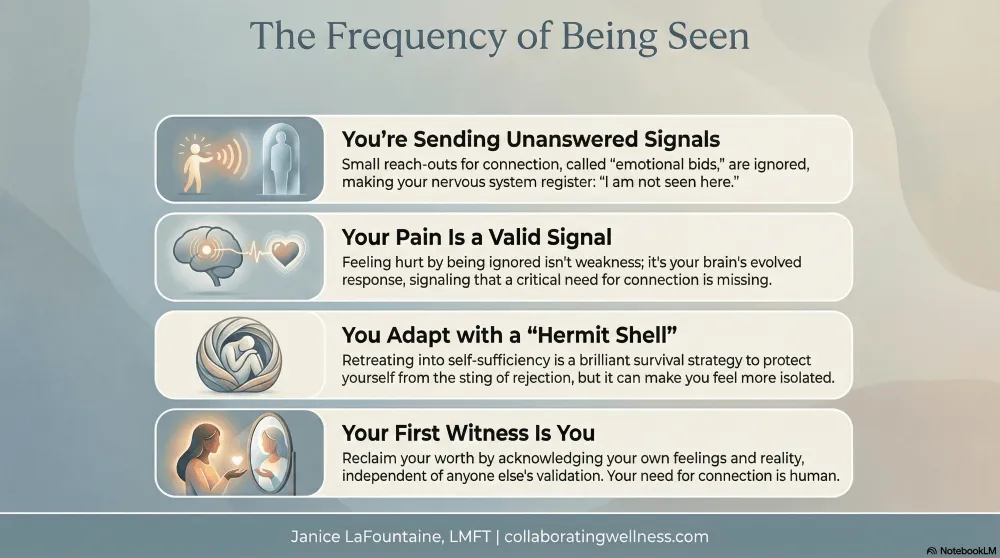
Gottman calls the smallest units of connection "bids"—tiny moments when we reach out for attention, affection, or acknowledgment. A comment about the weather. A hand on a shoulder. A "good morning." Every bid is a small request: See me. I'm here.
When you get silence in response, you've had a bid rejected. When it happens once, it stings. When it happens thousands of times over years, your nervous system arrives at a devastating conclusion: I am not safe here. I am not valued here. I am not seen.
"Think of yourself as a WiFi signal broadcasting 'I am here, I have needs, I matter.' But the family network has blocked your IP address."
They're connected to everyone and everything else—work, friends, devices, hobbies, their own internal worlds—but somehow, consistently, not to you. Whether conscious or unconscious, this pattern of dismissal rewires your brain's understanding of your own worth.
Is This Really Trauma, or Am I Being Too Sensitive?
The first step in Soul Unity Therapy is what I call Active Consciousness—the practice of seeing clearly what is, without the fog of gaslighting, minimization, or self-blame. So let's name what's true.
In The Body Keeps the Score, Dr. Bessel van der Kolk writes that relational trauma—the slow, grinding trauma of feeling unseen and unimportant to the people who matter most—shapes the nervous system as powerfully as any single shocking event. Emotional neglect is not the absence of abuse. It is its own form of wounding, and in many ways, one of the hardest to name because there's no bruise to point to.
You are experiencing relational disconnection. Research on attachment theory, beginning with John Bowlby and extended by researchers like Sue Johnson, shows that consistent emotional unavailability from a primary attachment figure creates what is called an "insecure attachment style." In adult partnerships, chronic emotional neglect functions the same way—only slower, quieter, and harder to identify.
This dynamic hurts because it's supposed to hurt. Your nervous system is designed to register disconnection as a threat to your wellbeing. Feeling pain about being ignored isn't weakness; it's your brain doing exactly what evolution built it to do—signal that something essential is missing.
Your bids for connection are not the problem. Wanting acknowledgment, conversation, and emotional presence from the people you live with is not "needy." It's human. Gottman's research demonstrates that turning toward bids—not ignoring them—is one of the single strongest predictors of relationship satisfaction and longevity.
The fact that you're broadcasting doesn't make you too much. The fact that no one's receiving doesn't mean you should stop transmitting. It means the relational environment is not meeting basic human needs for acknowledgment and connection. This pattern often lives alongside other relational wounds—see how your fight cycle is really a cry for connection for the related dynamic of couples who argue but cannot reach each other.
Why Do I Keep Shrinking Myself to Survive?
When you can't get connection, you do something brilliant: you stop asking for it.
I call this adaptive response the Hermit Shell—the retreat into hyper-independence to protect what's left of your dignity. If you don't reach out, you can't be rejected. If you don't need, you can't be disappointed. If you become completely self-sufficient, maybe it won't hurt so much when they walk past you like furniture.
This is a smart nervous system strategy. It's not pathology; it's adaptation. You are protecting yourself the only way available to you while still remaining in the dynamic.
But there is a cost. Inside the shell, you start to believe the story that you're unworthy of connection. You internalize the message that your needs are burdensome. You begin to shrink yourself, editing your personality down to whatever might finally be acceptable enough to be noticed. Sue Johnson, the founder of Emotionally Focused Therapy and author of Hold Me Tight, calls this phenomenon "emotional starvation"—the slow fading that happens when we stop reaching for what we've been taught we cannot have.
The Hermit Shell keeps you safe from the daily sting of dismissal, but it extracts a steep price: it requires you to abandon yourself before they can.
In my practice, I sit with clients who have lived inside this dynamic for years before they ever find words for it. The phrases that finally come — I don't matter, I'm invisible, no one cares about me, I might as well not be there — are often the truest things they say all session. The work isn't to argue them out of those feelings. It's to help them locate the part of themselves that knows their worth was never theirs to lose in the first place.
Why Doesn't "Just Talk About It" Ever Work?
You've probably tried to address this. Maybe you've said, "I feel invisible" or "I need more connection" or "Can we spend time together?" And maybe you've been met with defensiveness, dismissal, or the maddening response: "You're being too sensitive."
Here's why traditional relationship advice often fails in these dynamics: it assumes both people want connection and are simply missing each other's signals. But when one person has habitually tuned out the other's frequency, we are not dealing with a communication problem. We are dealing with a pattern of emotional unavailability that serves a function for the person doing the ignoring—whether that function is avoidance of intimacy, maintenance of control, or protection of their own discomfort.
"In healthy relationships, partners turn toward bids for connection about 86% of the time. In relationships heading toward dissolution, that number drops to 33%." — Gottman Institute research
If you're consistently experiencing dismissal, you're not imagining it. You're experiencing a measurable pattern of disconnection. This doesn't necessarily mean the relationship is doomed, but it does mean that traditional "have a conversation" advice won't shift a pattern this entrenched without both people genuinely wanting change. If the dynamic has edged into something more controlling, it may be worth learning to distinguish relational disconnection from the patterns described in Is It Really Trauma Bonding?.
What Do I Do With All This Loneliness?
So what do you do with the very real grief of living with people who don't see you?
First, let yourself feel it. This is Emotion Integration—the Soul Unity principle that healing happens not by bypassing emotions but by allowing them to move through you. The loneliness is real. The hurt is valid. The frustration is legitimate. These feelings aren't signs of your inadequacy; they are signals from your authentic self that something essential is missing.
Grounding Practice
When the loneliness feels overwhelming, try this somatic technique. Place one hand on your heart and one on your belly. Take three slow breaths. Say out loud or internally: "This hurts because I'm human and humans need connection. My need for acknowledgment is not a flaw—it's proof that I'm wired for love."
This isn't positive thinking. This is nervous system regulation combined with truth-telling. You are giving your body the message that even if others aren't acknowledging you, you can acknowledge yourself.
Second, externalize the pattern. The invisibility you're experiencing is not proof of your unworthiness—it's evidence of the other person's unavailability. Write this down if you need to: "Their inability to see me is about their limitations, not my value."
How Do I Stay Whole If I Can't Leave Yet?
You might not be ready to leave this relationship or family system. That's okay. Soul Unity Therapy honors your timeline and your autonomy. But you can still protect your sense of self while navigating this dynamic.
Five Strategies for Staying Whole
1. Reclaim your internal authority. Your worth is not determined by whether someone responds to your "good morning." Practice what I call Lovable Regardless—the truth that your inherent value exists independent of anyone's acknowledgment of it. This is an Inside Job. No one else can give you your worth, which means no one can take it away either.
2. Find witnesses elsewhere. You need connection—that is not negotiable for human wellbeing. If you can't get it at home, cultivate relationships where you are seen. A therapist, a close friend, a support group, an online community of people navigating similar dynamics. This isn't "replacing" your family; it's ensuring you get the basic relational nutrients required for psychological health.
3. Practice micro-acts of self-acknowledgment. When you walk into a room and no one looks up, practice noticing: "I just entered this space and I matter, whether they noticed or not." When you share something and get silence, internally affirm: "What I shared was worth sharing. Their lack of response is about them, not the value of what I offered."
4. Set limits on your availability. The Hermit Shell might be protective, but it shouldn't require you to over-function while under-mattering. If they don't respond to your bids, you don't have to keep making their lives comfortable at the expense of your own dignity. This isn't punishment—it's conservation of your energy for relationships where there is actual reciprocity.
5. Name the pattern when safe. If it feels safe, name what's happening without expecting it to change: "I notice that when I try to talk with you, you don't respond. I'm going to stop trying for now." Sometimes naming it removes the confusion and reclaims your reality, even if the dynamic doesn't shift.
What Happens When the Phoenix Child Finally Rises?
Here's what I want you to know from years of trauma work: the people who feel most invisible often have the strongest sense of self waiting to emerge.
What I call the Phoenix Child—that authentic, worthy, vibrant part of you—didn't die because people stopped seeing it. It went underground to survive. And when you're ready, when you've done enough Emotion Integration and built enough internal authority, that part of you will rise again.
Not because someone finally validated you. But because you learned to validate yourself. For many people, this reclamation unfolds slowly over time—and looks a lot like the process described in when healing means finding who you actually are.
"The loneliness of broadcasting to the void is real. But you are not the void. You are the signal—strong, worthy, and full of meaning, whether anyone else has tuned in or not."
When Should You Reach for Support?
If you're experiencing this dynamic and it's affecting your mental health, sleep, sense of reality, or daily functioning, please reach out for support. A trauma-informed therapist who understands relational patterns and attachment wounding can help you navigate this while protecting your wellbeing. If this dynamic is part of a larger pattern of control, you may recognize yourself in the invisible prison of coercive control.
If you're in Washington or Idaho and this resonates, I'd be honored to support you through EMDR, attachment-based therapy, or Gottman Method couples work if both partners are willing. This work is possible, and you deserve to be seen.
You're not too much. You're not too sensitive. You are a human being broadcasting on the frequency of connection in a system that has tuned you out.
That's not a flaw in your signal. It's a failure in their reception.
And either way, you get to decide: do I keep broadcasting into the void, or do I start tuning into the one person who's been there all along—myself?
Janice LaFountaine, LMFT, works with individuals and couples navigating complex trauma, attachment wounding, and relational disconnection. She offers EMDR, attachment-based therapy, and Gottman Method couples counseling via HIPAA-compliant telehealth throughout Washington and Idaho.
Disclaimer: This content is for educational purposes only and does not constitute medical advice or establish a therapeutic relationship. If you're experiencing a mental health crisis, please contact 988 (Suicide & Crisis Lifeline) or your local emergency services.
Continue reading in the Couples and attachment series
- How Your Fight Cycle Is Really a Cry for Connection — why the fight pattern is really an attachment cry.
- Understanding Your Attachment Style — why some nervous systems interpret bids as threat.
- When Your Partner Had an Affair: Why Betrayal is Trauma — the trauma of attachment rupture in a long relationship.
- The Blueprint Burden — invisibility's close cousin — the mental-load pattern.
- When Talk Therapy Hits a Wall — why couples' work often needs somatic repair, not just communication skills.