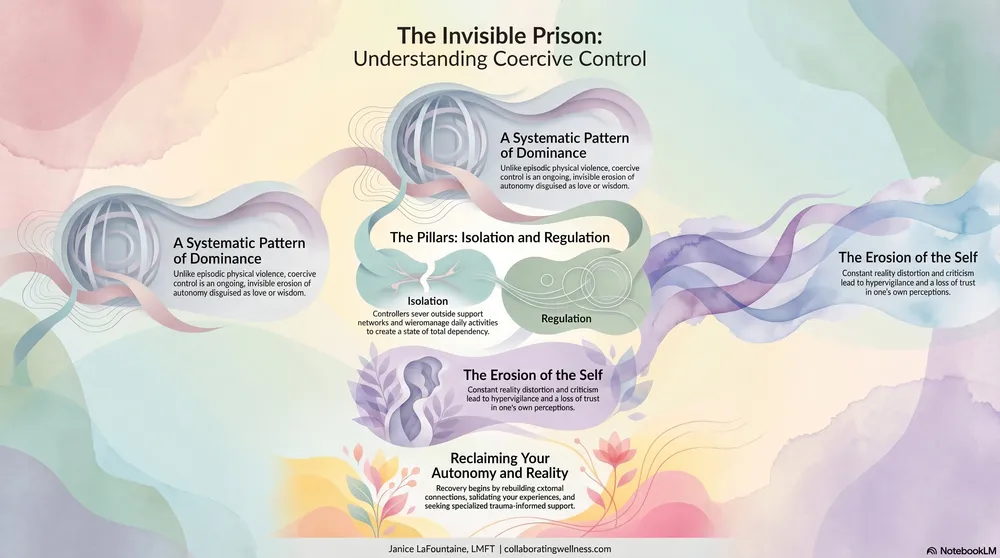
How psychological manipulation creates a cage without walls—and how to find your way out
Coercive control is a pattern of behavior designed to dominate, isolate, and manipulate individuals through psychological, emotional, and social tactics. While often associated with intimate partner violence, coercive control is also a defining characteristic of high-control groups and cult-like organizations. Understanding these dynamics is essential for recognizing when relationships or group memberships have become harmful and potentially dangerous.
Research by Dr. Evan Stark shows that coercive control is characterized by three core elements: isolation, control, and regulation of daily activities. These elements work together to create what researchers call "a prison without walls"—a psychological cage that can be more restrictive than physical confinement.
Key Takeaway: Coercive control is a systematic, pervasive pattern of psychological, emotional, and social manipulation that erodes autonomy, often disguised as care or truth.
What Is Coercive Control?
"Coercive control is a systematic pattern of dominance, isolation, and manipulation that creates a psychological prison, often more restrictive than physical confinement."
While physical abuse is episodic—occurring in specific incidents—coercive control is ongoing and pervasive. Physical violence leaves visible marks that fade; coercive control leaves invisible wounds that compound over time.
What makes coercive control particularly dangerous is how it disguises itself. It's often presented as caring, protection, or love. Controllers frequently frame their restrictions as being "for your own good" or as expressions of higher wisdom or spiritual truth. This reframing makes it difficult for targets to recognize abuse.
The most effective coercive control systems start with small, seemingly reasonable requests that gradually expand into comprehensive life control. This gradual process, sometimes called "the slippery slope," makes it difficult for targets to identify when boundaries have been crossed.
How Do I Know If I'm Experiencing Coercive Control?
Coercive control often develops gradually, making it difficult to recognize while you're in it. Here are key indicators that a relationship or group involvement may involve coercive control:
Red Flags to Monitor:
- Increasing isolation from previous relationships and activities
- Constant criticism disguised as help or guidance
- Restriction of information access or discouragement of outside perspectives
- Monitoring of activities, communication, or whereabouts beyond reasonable concern
- Financial control or restrictions on economic independence
- Decision-making power concentrated in the controller's hands
- Identity restriction through dictating appearance, beliefs, or behaviors
Pay attention to how you feel in the relationship. Persistent feelings of walking on eggshells, anxiety about pleasing the other person, or doubt about your own perceptions are important internal warning signs.
What Are the Three Pillars of Coercive Control?
Dr. Evan Stark's research identifies three core elements that work together to create the "invisible prison" of coercive control:
1. Isolation
One of the most powerful tools of coercive control is the systematic severing of relationships with family, friends, and support networks. This isolation serves multiple purposes: it eliminates outside perspectives that might question the controlling party's narrative, increases dependency on the controlling individual or group for emotional and practical needs, and reduces options for escape by removing potential sources of help or alternative viewpoints.
Controllers carefully manage what information their targets can access. This includes restricting access to news, alternative viewpoints, or critical analysis of the controlling party's beliefs or behaviors. The goal is to create an "information bubble" where only approved perspectives are available.
2. Control
Through constant criticism, micromanagement, and reality distortion, coercive controllers gradually erode their victim's sense of self. The target begins to doubt their own perceptions, judgment, and worth, making them increasingly dependent on the controller for validation and direction.
Effective coercive control relies on predictable consequences for non-compliance. These consequences don't need to be physical to be powerful. Social rejection, emotional withdrawal, public humiliation, or loss of privileges can be equally controlling.
3. Regulation of Daily Activities
Coercive control extends into the minutiae of daily existence. Controllers may dictate clothing choices, appearance, or personal grooming to maintain image control. They monitor and restrict communication with others, often under the guise of "protection." They control financial resources to create practical dependency. And they regulate time and activities to ensure constant surveillance and limit opportunities for independent thinking.
This level of regulation serves to reinforce the message that the target cannot be trusted to make decisions independently and must rely on the controller's "superior" judgment.
What Tactics Do Controllers Use to Maintain Power?
The Role of Fear and Consequences
Effective coercive control relies on predictable consequences for non-compliance. What makes these punishment systems particularly effective is their consistency—the target learns that any deviation from the controller's expectations will result in negative outcomes, creating a powerful incentive to comply.
Paradoxically, controllers often apply rules and consequences inconsistently, creating a state of chronic anxiety where the target never knows what might trigger punishment. This unpredictability increases compliance and hypervigilance. The target is forced into a constant state of alertness, trying to anticipate the controller's reactions and adjust their behavior accordingly.
The most insidious aspect of coercive control is often what's implied rather than explicitly stated. Targets learn that questioning or resistance leads to increasingly severe consequences, creating a climate of fear that prevents challenges to the controller's authority. Over time, the controller may not even need to explicitly threaten consequences; the target has internalized the threat and will self-regulate to avoid potential punishment.
Normalizing Control Through Ideology
Coercive control is often presented as caring, protection, or love. This masking of control as care is particularly effective because it plays on cultural narratives about love and protection. The target may even defend the controller to others, explaining that their controlling behavior is just a sign of how much they care.
In organizational settings, coercive control becomes a collective effort where other group members enforce compliance. This peer pressure creates multiple layers of surveillance and consequence, making the control system seem normal and inevitable. When everyone around you seems to accept and enforce the same rules and restrictions, it becomes much harder to question whether those rules are reasonable or healthy.
Information Control and Reality Distortion
Controllers carefully manage what information their targets can access. This includes limiting access to news and outside perspectives, discrediting any contradictory information sources, providing selective or distorted information, and creating an environment where the controller is the primary or only source of "truth."
Through constant criticism, micromanagement, and reality distortion, coercive controllers gradually erode their victim's sense of self. This erosion happens through constant criticism that undermines confidence, gaslighting that makes the target doubt their own perceptions and memories, isolation that removes external validation of the target's experiences, and intermittent positive reinforcement that keeps the target seeking approval.
Over time, the target may lose their sense of who they are outside of the relationship with the controller, making it even harder to envision leaving or resisting.
Why Is Coercive Control So Self-Reinforcing?
What makes coercive control particularly difficult to escape is its self-reinforcing nature. Each element strengthens the others:
- Isolation increases vulnerability to reality distortion
- Fear of consequences prevents resistance to increasing control
- Identity erosion makes it harder to trust one's own judgment about the situation
- Normalization makes the target less likely to seek help or recognize the abusive nature of the relationship
This interlocking system creates a powerful hold on the target that can persist even when physical restraint is not present.
How Does Coercive Control Affect Mental and Physical Health?
Chronic coercive control creates persistent activation of the body's stress response systems. This constant state of alert has profound effects on both mental and physical health:
Nervous System Impact:
- Anxiety and hypervigilance become default states
- Depression often develops as a response to persistent helplessness
- Difficulty concentrating and making decisions reflects the cognitive load of constant stress
- Physical symptoms like headaches, digestive issues, sleep disturbances, and chronic fatigue are common
- Dissociation may occur as a protective mechanism against ongoing psychological harm
Recognizing these as responses to an unhealthy environment, rather than personal failings, is crucial for recovery. Your body and mind are responding normally to abnormal circumstances.
In my practice, the first sign is often subtle — a client will share something and then look up to check whether it was okay to say. "I don't really have trauma," they tell me, "I'm not a veteran." They've been told for so long what to feel that they no longer know how to answer the question. Much of the early work is simply walking alongside them, patiently, while they begin to trust that what happened to them counted — and that I am not going to overwrite their reality the way someone else once did.
Can You Recover from Coercive Control?
Yes. Recovery is possible, though it requires both practical and psychological work.
Practical Steps
- Gradually rebuild connections with supportive people outside the controlling relationship
- Access independent information sources to counteract the information bubble
- Develop financial or practical independence where possible
- Create a safety plan if there are concerns about physical safety during separation
- Seek professional help from those who understand coercive control dynamics
Psychological Recovery
- Learn to trust your own perceptions again by validating your experiences
- Process the trauma of betrayal and loss with appropriate support
- Develop healthy boundaries and relationship patterns
- Recognize that healing is not linear—progress may include setbacks
- Be patient with yourself as you reclaim your autonomy and identity
This process takes time and often benefits from professional support. Therapists trained in trauma and coercive control dynamics can provide invaluable guidance during this journey.
The Path Forward: Rebuilding After Control
As you move forward, you may experience:
Identity reclamation – rediscovering who you are outside the controlling relationship
Decision fatigue – feeling overwhelmed by choices after having few options
Relationship recalibration – learning to form connections based on equality rather than control
Grieving – processing the loss of what you thought the relationship was
Post-traumatic growth – developing new insights, strengths, and resilience
Remember that recognizing coercive control patterns is not about blame or shame—these systems are designed to be difficult to detect and resist. Your nervous system's responses to these environments are protective, not pathological.
With time, support, and often professional guidance, it's possible to rebuild autonomy, healthy relationships, and trust in your own judgment.
Frequently Asked Questions About Coercive Control
Can coercive control happen in families?
Yes. Coercive control dynamics can occur in parent-child relationships, between siblings, or within extended family systems—particularly in high-control family cultures or authoritarian parenting structures.
Is coercive control illegal?
This varies by location. Some jurisdictions (including Scotland, England, Wales, and some U.S. states) have criminalized coercive control in intimate partner relationships. However, many places still lack specific legal frameworks to address non-physical abuse.
How long does recovery from coercive control take?
Recovery timelines vary significantly based on the duration and intensity of the control, available support systems, and individual circumstances. Many people find that intensive work in the first 1-2 years creates significant progress, though deeper healing may continue for years.
Can someone who uses coercive control change?
Change is theoretically possible but requires the controlling person to: (1) genuinely recognize the harm they've caused, (2) take full responsibility without minimization, (3) commit to intensive specialized treatment, and (4) accept that rebuilding trust may take years—if it's possible at all. This level of change is rare and should not be expected or relied upon when making safety decisions.
What's the difference between coercive control and healthy relationship influence?
Healthy relationships involve mutual influence where both people's needs, perspectives, and autonomy are respected. Coercive control is unidirectional—one person systematically undermines the other's autonomy, self-trust, and freedom. Healthy influence expands your world; coercive control systematically shrinks it.
Breaking the Cycle
Understanding coercive control doesn't just help individuals recover; it helps break intergenerational cycles and creates awareness that can protect others. By recognizing these patterns, discussing them openly, and supporting those affected, we contribute to a culture that values autonomy, respect, and healthy relationships.
Coercive control operates through systematic patterns that gradually erode a person's autonomy, self-trust, and connection to outside support systems. Unlike physical violence, which is episodic, coercive control is ongoing and pervasive, creating an environment where the victim's reality becomes increasingly distorted and their options for independence systematically eliminated.
Continue reading in the Coercive Control recovery series
- Why "Narcissist" Became the Label We Can't Stop Using — what the word actually means clinically, and why precision matters for healing.
- Living With—and Leaving—a Narcissistic Partner — the idealization-devaluation-discard cycle and the neurobiology of staying.
- Understanding Your Attachment Style — why the bond holds even after you see the pattern.
- When Talk Therapy Hits a Wall — why insight alone isn't enough, and what somatic work adds.
- When Healing Means Finding Who You Actually Are — identity restoration as the next layer after safety.
If these patterns sound familiar and you're in Washington or Idaho: I specialize in trauma recovery and coercive control, including recovery from high-control groups and manipulative relationships. Whether you need help understanding what you experienced or support rebuilding after leaving, therapy can help you reclaim your sense of self and reality.