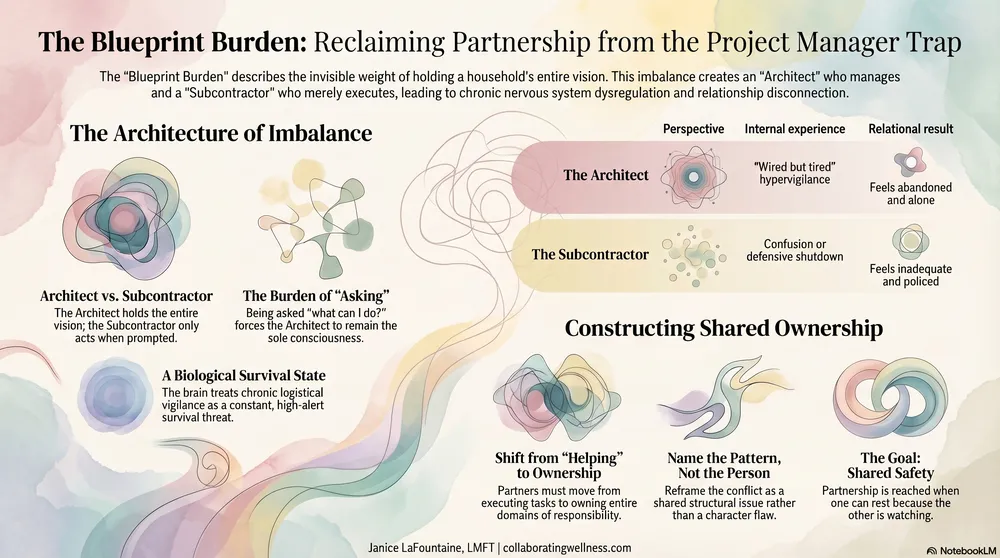
The Blueprint Burden: Reclaiming Partnership from the Project Manager Trap
You're not asking for help anymore. You're assigning tasks.
The difference might seem semantic, but your nervous system knows the truth. When you ask for help, there is a Pillar standing next to you. When you assign tasks, you've become the unpaid Project Manager of a household that was supposed to be a collaboration. This dynamic often fuels the fight cycles that feel like they're about nothing and everything.
It's Tuesday at 7:43 PM. You remember—mid-sentence in a work conversation—that your kid needs a specific colored folder for tomorrow's presentation. You also remember that the dog's medication is running low, that your mother-in-law's birthday is Saturday and you haven't ordered a card, that the car registration is due next week, and that someone needs to call the insurance company about that billing error. Your partner, sitting three feet away, is peacefully scrolling their phone. Untroubled. Unaware. Because in their mind, everything is handled. And they're right—it is handled. By you. Always by you.
You hold the entire blueprint in your head—the dentist appointments, the social calendar, the invisible emotional check-ins, and the seventeen steps that precede the one visible task your partner finally notices. You are exhausted in a way that sleep doesn't fix—a loneliness that mirrors broadcasting to the void.
This is what I call The Blueprint Burden: the invisible, crushing weight of being the only one who holds the vision for your shared life.
Why Does One Partner Become the Architect?
The mental load is the invisible cognitive labor of managing a household—anticipating needs, tracking tasks, planning logistics, and carrying the emotional weight of ensuring everything gets done. Sociologist Allison Daminger (2019) found that women perform significantly more of this cognitive labor, even in otherwise egalitarian partnerships.
In my work with couples, I often see a divide that shifts the entire foundation of the "Sound Relationship House". It's the gap between doing and seeing.
- The Architect holds the whole picture. They don't just "do" the laundry; they see the sequence. They know when the detergent is low, when the kid's soccer uniform needs to be clean for Thursday, and when the washing machine started making that "expensive" sound. They carry the mental weight of every moving part.
- The Subcontractor is often competent and even willing. They'll do what's asked—usually with a "Just tell me what you need!" But that question is, itself, a burden. It forces the Architect to remain the sole "Active Consciousness" of the home.
Here's what this looks like in practice: The Architect notices the bathroom sink is draining slowly. They don't just notice it once—they track it over several days, determining whether it's getting worse. They research solutions, add "drain cleaner" to the mental shopping list, remember which brand worked last time, and note that if it doesn't improve by Friday, someone will need to call a plumber before the weekend guests arrive. They're also aware that calling the plumber means rearranging Thursday's schedule, which conflicts with the dentist appointment, which means...
The Subcontractor uses the same sink every day and doesn't register that it's draining slowly. When it finally backs up completely on Saturday morning—right before the guests arrive—they're genuinely confused about why their partner seems stressed. "Why didn't you say something?" they ask. As if the Architect hasn't been managing this whole chain of contingencies silently for two weeks.
"If you're the Architect, explaining this feels like describing a color they've never seen. You can't photograph the load, so you start to wonder if you're just being difficult. Let's be direct: the belief that you are 'too much' or 'difficult' is bullshit. You aren't being difficult; you're being unsupported."
Why Isn't This Just Stress?
Most "mental load" articles treat this as a fairness issue—who does more chores, who plans more events, who remembers more birthdays. They're not wrong, but they're missing the deeper truth. At Soul Unity Therapy, we look at the neurobiology. This isn't just annoying; it is biologically expensive.
Your brain was designed to track threats. When you are the only one monitoring the logistical and emotional landscape, your nervous system treats that vigilance as survival work. Your "Smoke Detector" (the amygdala) stays in a state of high alert because it doesn't trust that anyone else is watching the horizon.
Think about what happens when you're the only one home with a toddler. Your nervous system doesn't fully relax, even when the child is napping. Some part of you is always listening, always ready, always monitoring. You can't sink into deep rest because you're the only failsafe. Now imagine living that way 24/7—not just with a toddler, but with every single aspect of your household, your schedule, your family's emotional needs. That's the Blueprint Burden.
That "wired but tired" feeling? That's your body being stuck in the Sympathetic branch of your nervous system—the fight-or-flight lane. You're scanning for what hasn't been noticed, bracing for what will fall through the cracks if you let go of the blueprint for even a second. Your brain is saying: I cannot be the only monitoring system indefinitely.
The neuroscience is clear: chronic activation of this threat-detection system leads to elevated cortisol, disrupted sleep, difficulty concentrating, and a nervous system that can't find its way back to the Ventral Vagal state of social connection and safety. You become irritable not because you're "high maintenance" but because your nervous system is chronically dysregulated from carrying a load it was never designed to carry alone.
This is why a bubble bath won't solve this. You don't need "self-care"; you need your partner to step into the Social Engagement System with you and start carrying the sentinel's watch. You need someone else's nervous system to signal to yours: I've got this too. You can rest.
What Is the Invisible Ledger in Your Relationship?
The Architect keeps a ledger that the Subcontractor doesn't know exists. It tracks things like:
- The number of times you've preemptively handled something before it became a crisis
- The emotional labor of remembering what makes each family member feel loved
- The mental gymnastics of coordinating schedules across multiple people, preferences, and priorities
- The "worry work" you do at 2 AM about things that haven't happened yet but could
- The number of times you've explained the same system, only to have it ignored or forgotten
This ledger isn't about scorekeeping—it's about recognition. The Architect isn't asking for a medal. They're asking for their labor to be seen as labor. They're asking to not be the only one who notices when the household is about to run off the rails.
And here's the cruel irony: the better you are at carrying the Blueprint Burden, the more invisible your work becomes. Success looks like nothing happening. The crisis that was averted, the conflict that was prevented, the disaster that never materialized—none of it is visible. Your partner sees a smoothly running household and thinks, "Everything's fine." They don't see you behind the curtain, frantically spinning plates.
What Happens When the Protest Polka Takes Over?
In Emotionally Focused Therapy (EFT), we call the resulting conflict the Protest Polka. It's a dance where nobody wins, but it points to a deep attachment need:
Driven by a primal attachment cry—"I need to know I'm not alone in this!"—the Architect leads with complaints or criticism. They might snap about the dishes, the scheduling, the fact that they're the only one who seems to care about anything. But underneath that frustration is a raw vulnerability: Do I matter enough for you to pay attention?
The Subcontractor, feeling inadequate or "policed," withdraws into defensiveness or shut-down. They might say, "I can't do anything right," or "You're always criticizing me," or simply go silent. Which, of course, confirms the Architect's fear: that they are running this family while pretending to have a partner.
Both people are hurting. The Architect feels abandoned and alone. The Subcontractor feels inadequate and controlled. And the real enemy—the invisible structure that makes one person responsible for everything—goes unchallenged.
The Research is Clear
Gottman Institute research confirms that couples who "turn toward" each other's small bids for connection 86% of the time stay married. The Blueprint Burden isn't just about chores; it's about a thousand small moments where one partner needed to feel seen and supported—and wasn't. Every time the Architect mentions something that needs doing and gets met with silence or a dismissive "I'll get to it," that's a bid for connection being rejected. Over time, those rejections accumulate into profound loneliness.
What Actually Helps Break the Pattern?
Let's be honest: there's no quick fix here. This pattern didn't develop overnight, and it won't resolve with a single conversation. But there are concrete steps that can begin to shift the dynamic.
If You're the Architect:
1. Stop over-functioning to manage your anxiety. This is the hardest one, I know. As long as you catch every ball before it drops, your partner's brain has no biological reason to start tracking them. We have to expand your Window of Tolerance for a little bit of "dropped-ball" chaos to allow room for change.
What this looks like in practice: Let the permission slip not get signed. Let the groceries run out. Let your partner experience the natural consequence of not monitoring. Yes, this will create temporary discomfort. But discomfort is often the only thing that motivates change.
2. Name the pattern, not the person. Instead of "You never think of these things," try "I notice I'm holding the entire blueprint alone, and it's putting my nervous system into survival mode. I need to know we're a team." This is attachment language—it speaks to the relationship structure rather than attacking character.
3. Be specific about what shared responsibility looks like. "I need more help" is too vague. Try: "I need you to own the kids' medical appointments—scheduling them, tracking when they're due, following up on referrals, all of it. Not helping me with it. Owning it." Define ownership clearly.
4. Recognize when you're using the Blueprint as anxiety management. Sometimes controlling everything feels safer than trusting someone else to care. If your partner is genuinely trying and you're still unable to release control, that's worth exploring in your own therapy. The question becomes: what are you protecting yourself from by staying indispensable?
If You're the Subcontractor:
1. Stop waiting to be asked. Real partnership means developing your own internal "Watchtower". Look around—what might need doing? What's your partner always managing? What would make their day easier? Start tracking what they track without being prompted.
This means noticing when the trash is full, when supplies are running low, when schedules need coordinating. It means thinking ahead instead of only responding to immediate requests. Your partner shouldn't have to manage you like an employee.
2. Believe your partner. Even if you can't "see" the load, trust that your partner's exhaustion is real and their nervous system is depleted. Stop minimizing with phrases like "It's not that bad" or "You stress yourself out." Their experience is valid whether or not you understand it.
3. Take full ownership of specific domains. Don't just "help with" dinner—own meal planning, grocery shopping, and cooking for specific days. Don't just "pitch in" with kids' activities—own the entire calendar for one child. Full ownership means your partner never has to think about it unless they want to.
4. Understand that "your way" of doing things isn't the only valid approach. If your partner has a system that works, honor it instead of insisting on doing things your way. The goal is to lighten their load, not to create more work by doing it differently enough that they have to re-do it.
5. Sit with the discomfort of not knowing. You're going to feel incompetent at first. You're going to forget things, miss details, do things "wrong." That discomfort is part of learning. Your partner has been feeling incompetent for years under the weight of doing everything. It's your turn to lean into the learning curve.
What Does Healing Actually Look Like?
When this pattern begins to shift, it's not dramatic. You won't suddenly have a perfectly balanced household where everything is 50/50. But you will notice small changes:
- The Architect starts to feel their shoulders drop when they walk in the door, because they trust that someone else has been watching
- The Subcontractor proactively mentions something they noticed needs attention, without being prompted
- When something falls through the cracks, both people approach it as a shared problem to solve rather than evidence that one person is failing
- The Architect can take a day off—actually off, where their brain doesn't have to track anything—and trust that life will continue
- Resentment begins to soften into something more tender: the recognition that you're both learning a new dance
True partnership isn't about perfect equality in every moment. It's about both people feeling like they can lay down the weight sometimes and trust that the other will pick it up. It's about moving from parallel lives—one person managing while the other coasts—into genuine collaboration.
When Should You Reach for Professional Support?
If this pattern has calcified into contempt or total emotional numbing, you can't "to-do list" your way out of it. You need a space where the "Demon Dialogues" can be dismantled and the underlying attachment bond can be restructured.
In my practice, I combine the structural tools of the Gottman Method with the deep attachment work of EFT. Together, we address the injury underneath so the Architect can finally feel safe enough to set the blueprint down. We help the Subcontractor understand that stepping up isn't about being controlled—it's about honoring the partnership they claim to want.
This isn't about assigning blame. It's about recognizing that you're both trapped in a pattern neither of you chose consciously, and that pattern is eroding the connection you both need. With the right support, you can build something different—something where burden is shared and partnership is real.
"You weren't meant to run your life alone—especially not while someone is standing right next to you."
Janice LaFountaine, MS, LMFT
Soul Unity Therapy | Spokane, WA & Idaho (Telehealth)
Disclaimer: This content is for educational purposes only and does not constitute medical advice or establish a therapeutic relationship. If you're experiencing a mental health crisis, please contact 988 (Suicide & Crisis Lifeline) or your local emergency services.
Continue reading in the Couples and attachment series
- How Your Fight Cycle Is Really a Cry for Connection — when mental-load friction surfaces as demand-withdraw cycles.
- Understanding Your Attachment Style — why the over-functioning partner often has hyperactivating attachment.
- Broadcasting to the Void — when the invisible labor becomes emotional invisibility too.
- When Your Partner Had an Affair: Why Betrayal is Trauma — how sustained over-functioning creates trauma-adjacent exhaustion.
- When Talk Therapy Hits a Wall — why nervous-system regulation has to come before communication work.