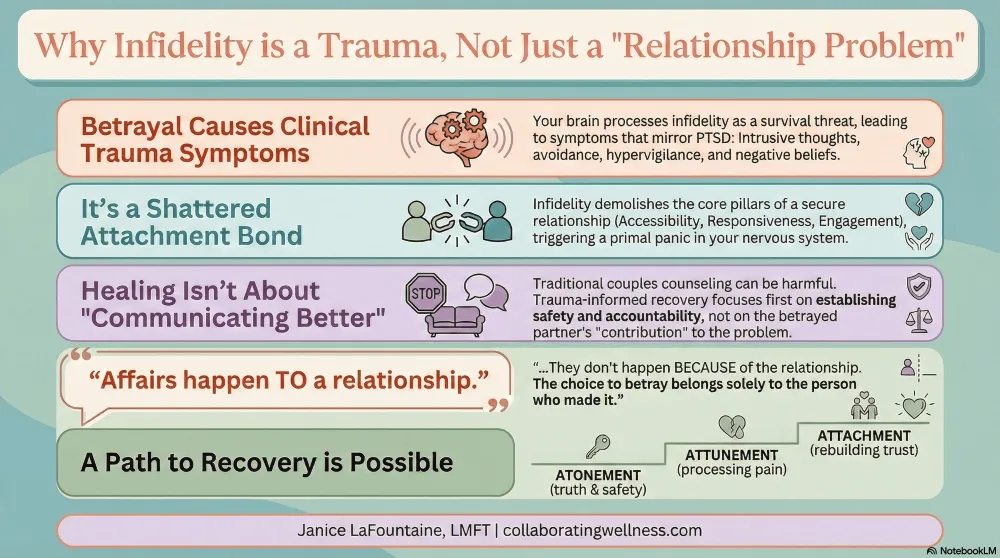
When Your Partner Had an Affair: Why Betrayal is Trauma (Not Just a 'Relationship Problem')
You can't sleep. You replay every conversation, every timeline, searching for clues you missed. Your body floods with panic when your partner's phone buzzes. You feel like you're losing your mind—except you're not. Your nervous system is doing exactly what it's designed to do when your reality has been shattered. (This is related to, but distinct from, trauma bonding.).
If your partner had an affair, you're not experiencing a "rough patch" or "trust issues." You're experiencing betrayal trauma—a pattern distinct from the everyday fight cycles most couples navigate. And understanding this distinction changes everything about your path forward.
As a trauma specialist and Gottman-trained couples therapist in Spokane, I work with couples recovering from infidelity. What I see repeatedly: traditional couples therapy that treats affairs as "communication problems" or asks both partners to examine "what went wrong in the relationship" often makes things worse. Because betrayal isn't a relationship problem—it's a trauma response that requires trauma-informed treatment.
Why Does Betrayal Create Clinical Trauma Symptoms?
Betrayal trauma is a specific form of relational injury in which a trusted attachment figure violates the foundational agreements of the relationship. Shirley Glass (2003) distinguished this from general relationship conflict: the threat comes from inside the bond itself, shattering the partner's model of reality and safety simultaneously.
When your partner violates the fundamental agreements of your relationship through a clandestine emotional or sexual liaison, your brain processes this as a survival threat. The research from the Gottman Institute shows that betrayed partners often develop symptoms that match DSM-5 criteria for Post-Traumatic Stress Disorder (PTSD):
Clinical Symptoms of Betrayal Trauma
- Intrusive symptoms: Flashbacks to discovering the affair, intrusive thoughts and images, nightmares about the betrayal
- Avoidance: Avoiding places, people, or conversations that remind you of the affair; emotional numbing to cope with overwhelming pain
- Negative thoughts: "I can never trust anyone," "I'm not enough," "My reality was a lie," persistent detachment from others
- Hyperarousal: Constant vigilance watching for signs of deception, exaggerated startle response, difficulty sleeping, checking phones or emails compulsively
This isn't weakness. This isn't you "making it worse by not moving on." This is your nervous system responding appropriately to the discovery that the person you trusted most violated the foundation of your relationship. From a neurobiology perspective, infidelity shatters your "internal scaffolding"—the core assumption that your world is safe and predictable.
Why "Just Communicating Better" Doesn't Work
Traditional couples therapy often focuses on improving communication skills, exploring what went wrong in the relationship, or helping both partners take responsibility for "their part" in the breakdown. But when trauma is present, these approaches can actually deepen the wound.
Here's what happens: When therapists ask betrayed partners to examine "what you contributed to the affair," it creates a secondary injury. It's the therapeutic equivalent of asking a trauma survivor what they did to cause their trauma. The message the betrayed partner receives is: Your pain isn't valid until you admit your complicity.
"Affairs happen TO a relationship. They don't happen BECAUSE of the relationship. The choice to betray belongs solely to the person who made it."
This distinction is crucial. Yes, relationships have problems. Yes, both partners contribute to relationship dynamics. But the decision to have an affair—to choose secrecy, deception, and violation of trust—is a unilateral choice made by one person. Trauma-informed therapy holds this truth while still working toward healing.
What's the Attachment Wound Behind Every Affair?
Through the lens of attachment theory—the scientific framework that explains how humans bond—infidelity represents a catastrophic breach of the attachment bond. In healthy relationships, partners implicitly rely on three pillars of secure attachment (what researchers call the A.R.E. framework):
Accessibility: "Can I reach you? Are you emotionally available to me?"
Responsiveness: "Will you respond to me when I need you?"
Engagement: "Do I matter to you? Am I valued and cherished?"
An affair demolishes all three pillars simultaneously. The betrayed partner discovers they could not reach their partner (who was emotionally invested elsewhere), their partner was not responsive to their needs (choosing to build intimacy with someone else instead), and they were not valued (their partner prioritized another relationship over the primary bond).
This triggers what attachment researchers call "primal panic—a response rooted in your attachment style"—the survival-level fear that comes from losing your safe haven. It's why betrayed partners often describe feeling like they're drowning, like the ground disappeared beneath them, like they can't breathe. These aren't metaphors. These are accurate descriptions of what happens in your nervous system when the attachment bond shatters.
How Do Relationships Become Vulnerable to Affairs?
Understanding how affairs happen doesn't excuse them—but it does provide a roadmap for prevention and repair. The Gottman research identifies a predictable 24-step cascade that precedes most affairs. This cascade shows how relationship barriers break down over time, creating vulnerability to betrayal.
Phase I: The Erosion of Trust begins with partners turning away from each other's bids for connection, feeling unsupported, and experiencing frequent flooding (physiological overwhelm) during conflicts. Repairs stop working. To maintain peace, couples start avoiding conflict and keeping secrets.
Phase II: The Rise of Loneliness introduces what researchers call "negative comparisons"—when a partner starts thinking, "I could do better with someone else." Emotional investment in the relationship decreases. Partners stop making sacrifices for each other and begin mentally criticizing their spouse while minimizing their positive qualities.
Phase III: The Crossing of Boundaries culminates when a partner complains about their spouse to outsiders, experiences profound loneliness despite being in a relationship, and crucially—reverses "walls and windows." They build an emotional wall against their partner while opening a window of intimacy to an outsider. This sets the stage for the active pursuit of an affair.
This cascade explains how affairs occur, but it doesn't justify them. At every step, the person who eventually betrays made choices. The cascade shows opportunities for intervention—moments when the relationship was signaling distress and both partners could have chosen to address it.
What Does Trauma-Informed Affair Recovery Look Like?
The Gottman Method's approach to infidelity recovery is built on three sequential phases: Atonement, Attunement, and Attachment. Each phase addresses specific trauma-healing needs:
Atonement establishes truth and safety. The partner who had the affair takes full responsibility, expresses genuine remorse, provides complete transparency, and proves through verifiable actions that the betrayal has stopped. This phase enforces the "No Why Rule"—discussions about "why the affair happened" are postponed because early examination of marital problems allows the betrayer to rationalize their choice and prevents genuine remorse from developing.
Attunement focuses on processing the immense pain of betrayal together. Using the A.T.T.U.N.E. framework (Awareness, Turning toward emotion, Tolerance of different viewpoints, Understanding, Non-defensive listening, Empathy), the hurt partner's trauma symptoms are validated and metabolized. The goal isn't forgiveness—it's creating space for the pain to be witnessed without defensiveness.
Attachment involves rebuilding intimacy and creating what the Gottman research calls "Marriage #2"—a new relationship built on radical honesty and the science of trust, fundamentally different from the marriage that preceded the affair. This isn't about "getting back to how things were." It's about building something more resilient from the ruins.
What Betrayed Partners Need to Know
- Your intense reactions are normal trauma responses, not "holding a grudge"
- You don't need to "get over it" on anyone else's timeline
- Wanting to check phones or ask detailed questions is a valid part of re-establishing safety
- You're not "making the affair bigger than it needs to be"—betrayal trauma is that significant
- Recovery is possible, but it requires the betraying partner to do genuine repair work
Is Post-Traumatic Growth Really Possible After an Affair?
Research on post-traumatic growth shows that trauma doesn't just damage—it can also deepen. Couples who recover from infidelity using trauma-informed approaches often report that their "second marriage" is more honest, more intimate, and more resilient than their first. Not because the affair was "worth it" or "meant to be," but because they faced something devastating together and chose to rebuild with intention.
This growth requires several conditions: The betraying partner must demonstrate consistent, verifiable trustworthiness over time. The betrayed partner must be allowed to heal at their own pace without pressure to "move on." Both partners need to understand the neurobiology of trauma and the attachment science that explains why this hurts so profoundly. And the couple needs a therapist trained in trauma-informed approaches to infidelity—not generic couples therapy.
Recovery timelines vary. The Gottman research suggests that genuine repair from an affair typically takes 18 months to 3 years when working with a specialized therapist. That's not "a long time"—that's appropriate for healing from trauma while simultaneously building an entirely new relationship foundation.
Where Can You Find Specialized Support?
If you're in Eastern Washington or Idaho and dealing with the aftermath of an affair, working with a therapist who understands both trauma treatment and couples therapy is essential. Generic couples counseling—even well-intentioned—can inadvertently re-traumatize betrayed partners by prematurely pushing forgiveness, minimizing the severity of betrayal, or treating the affair as a symptom of relationship problems rather than as a trauma event.
As a trauma specialist and Gottman-trained therapist, I integrate evidence-based couples approaches with trauma-focused treatment like EMDR and attachment-based therapy. This combination addresses both the relationship dynamics that created vulnerability and the trauma symptoms the betrayed partner is experiencing. We don't rush healing. We don't bypass pain. We create the conditions for genuine repair.
If you're not sure whether your relationship can survive an affair, or whether you even want it to, that uncertainty is normal. What matters most right now is getting support that treats your experience with the gravity it deserves. Betrayal trauma is real. Your symptoms make sense. And with the right approach, healing is absolutely possible—whether that healing happens within the relationship or leads you toward a different future.
You're not broken. You're not "too sensitive." You're having a normal response to an abnormal event. And that response deserves trauma-informed care.
Disclaimer: This content is for educational purposes only and does not constitute medical advice or establish a therapeutic relationship. If you're experiencing a mental health crisis, please contact 988 (Suicide & Crisis Lifeline) or your local emergency services.
Continue reading in the Couples and attachment series
- How Your Fight Cycle Is Really a Cry for Connection — the fight patterns that sometimes precede and follow betrayal.
- Understanding Your Attachment Style — why betrayal hits specific attachment styles differently.
- The Blueprint Burden — the relational exhaustion that sometimes precedes betrayal.
- Broadcasting to the Void — when bids for connection are chronically unanswered.
- Is It Really Trauma Bonding? — when betrayal keeps cycling with apology — the intermittent-reinforcement pattern.