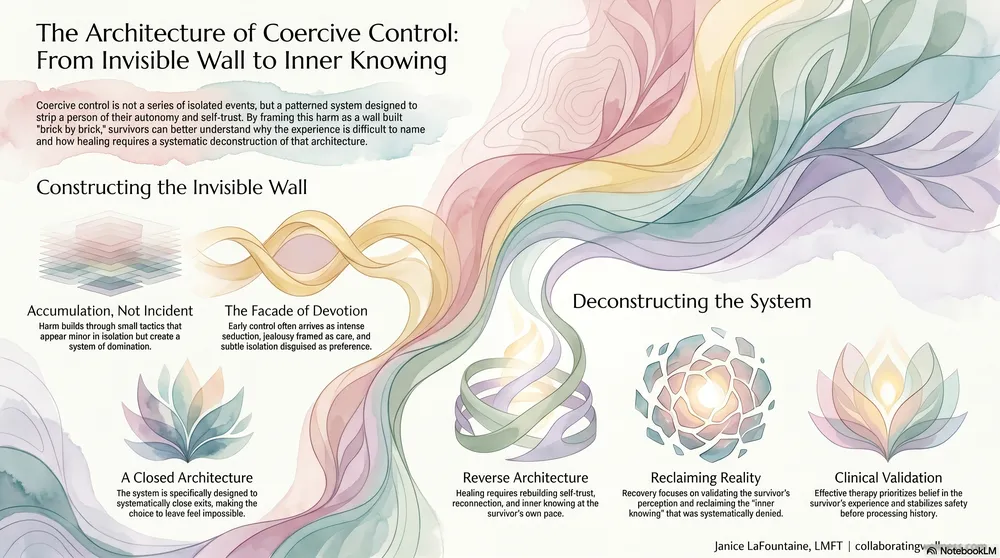
All at once, you felt trapped. You just didn't see the wall being built.
Coercive control is a pattern of behavior — within intimate partner relationships, families, and sometimes high-control groups — in which one person systematically limits another person's autonomy, freedom, and sense of self. First defined by sociologist Evan Stark in his foundational 2007 work Coercive Control: How Men Entrap Women in Personal Life, the framework recognizes that psychological and behavioral domination causes profound harm independent of physical violence. Coercive control operates through accumulation rather than through isolated incidents — which is why survivors frequently struggle to describe it. The tactics are designed to restrict resources, produce isolation, erode self-perception, and undermine trust in one's own reality. Understanding coercive control as a patterned system rather than a series of separate events is foundational to recognizing it and, eventually, to healing from it.
If you've ever tried to explain what happened in a controlling relationship — and found yourself unable to point to a single moment that would make sense to someone on the outside — you're not alone in that experience. That difficulty isn't evidence that nothing happened. It's actually evidence of how coercive control works. The harm rarely arrives in one identifiable event. It builds, brick by brick, until one day you look up and realize you've been enclosed in something that took years to construct.
Clinical social worker Jennifer Parker, MSSW, offers a framework that many survivors find clarifying. In her work with people navigating coercive relationships, she describes the tactics of control as "bricks" — individual behaviors that, in isolation, might appear minor, understandable, or even affectionate. It is only when you step back far enough that you can see the wall those bricks have formed: a wall that gradually closes off freedom, connection, self-knowledge, and the ability to trust your own perception.
While this article focuses primarily on intimate partner relationships, the same brick architecture appears in high-control religious groups, families, organizations, and communities — what researchers sometimes call coercive groups or cults. Steven Hassan’s BITE Model identifies four domains through which these groups exert control: Behavior, Information, Thought, and Emotional control. The tactics are remarkably consistent across contexts. Whether the controlling force is a partner, a religious leader, or a closed community, the experience of a narrowing world — fewer outside perspectives, eroding self-trust, mounting difficulty imagining life outside the system — follows a recognizable pattern. For people who grew up inside these groups, the experience differs from those who were recruited as adults: the bricks were laid before there was a self fully formed enough to notice them. Both deserve specific, informed support.
This article walks through twelve categories of controlling behavior — not as a diagnostic checklist, but as a way of offering language. Because sometimes the right name for a thing is the first thing that allows us to finally understand what we've been carrying.
Why Is It So Hard to Name What Happened?
Survivors of coercive control say things like: "Nothing was ever quite bad enough to leave." Or: "I can't explain what happened — and then one day I just felt trapped." Or, very quietly: "I don't know when it changed."
This isn't vagueness — it's precision. The harm of coercive control accumulates through many behaviors across a long period of time, which means it often defies the kind of clear narrative that others can follow from the outside. The wall didn't appear overnight. Each brick was placed carefully: often with explanation, often with warmth, often in ways that made sense in the moment. Stark's research frames coercive control as a liberty crime — an ongoing pattern of domination — rather than a set of discrete incidents. That reframing matters deeply for survivors, because it validates the experience of real harm even when no single moment seems severe enough on its own.
What Do the First Bricks Look Like?
The earliest bricks in a controlling relationship are among the hardest to recognize — because they often arrive looking like devotion. Parker names these the bricks of seduction: wanting to spend all your time together, taking over tasks and errands "so you don't have to worry," expressing jealousy as evidence of feeling deeply, steering choices — what you wear, who you see, where you go — under the framing of care and preference.
These behaviors don't register as controlling at first. They feel attentive. They can feel like finally being chosen. The escalation is gradual — which is part of what makes the pattern effective. By the time seductive behaviors have become genuinely restricting ones, a foundation has already been laid.
The bricks of isolation tend to follow. Contact with friends and family doesn't necessarily stop through direct prohibition — it becomes costly. Friction appears before social events. Going out gets framed as disloyalty. Over time, the psychological energy required to maintain outside connections outweighs what's available, and the world quietly narrows. From the outside, none of this looks forced. It usually looks like a choice.
You notice the wall. You don't notice each brick as it's laid. This is how coercive control works — and why "I can't explain it" is one of the truest things a survivor can say.
How Does Control Erode a Sense of Self?
Once isolation has reduced the outside perspectives that might offer balance, other kinds of bricks begin to set. The bricks of devaluation — destructive criticism, belittling comments, picking apart accomplishments, correcting everything you say — work not through dramatic attacks but through the accumulation of small dismissals. Over time, these alter how you see yourself. Chronic psychological stress of this kind taxes the nervous system in ways that are as real and as lasting as acute traumatic events.
The bricks of negation compound this. When your perceptions, needs, and feelings are consistently denied — when you're told you're too sensitive, that what happened didn't happen, that you're imagining things — the effect is a deep erosion of trust in your own inner knowing. This pattern is often called gaslighting: a systematic denial of your reality that can leave even a grounded person questioning their memory, their judgment, sometimes their sense of what is real.
Alongside negation, the bricks of neglect and betrayal remove the relational foundation you might otherwise lean on: withholding support during grief, making significant decisions without consultation, using confidences as ammunition. These behaviors deepen a felt sense of not mattering — and of being alone inside a relationship that was supposed to feel like partnership.
You may recognize some of these experiences:
- Needing to earn basic warmth or support — and not always succeeding
- Doubting your memory of events you directly witnessed
- Hearing your needs described as selfish or excessive
- Feeling invisible or unreal, even inside a relationship you thought was close
These are common responses to sustained devaluation and negation. They are not signs of weakness or gullibility. They are signs that the pattern was doing exactly what it was designed to do.
What Happens When Control Extends to Your Children?
For parents, one of the most devastating dimensions of coercive control can be when the behavior extends to children. Parker names this a distinct category: the bricks of alienation from children. When a controlling partner undermines your parenting authority, speaks disparagingly about you to your children, withholds information that affects your ability to care for them, or works to erode the bond between you and them — this is not a secondary harm. Many survivors describe it as the wound that cut deepest. It is also among the most complex to navigate, and therapeutic support specifically for this dynamic can make a meaningful difference for both parent and child.
Children in these situations often reflect the controlling parent's behavior — not because they are choosing it, but because they are absorbing what they have been taught. Responding to this as a parent rather than reacting to it as if to the controller is one of the most important and most difficult things to hold onto. That a child can feel safe enough with you to express difficult feelings — even ones that have been put there by someone else — says something significant about the relationship you still have with them.
What Happens When Fear Becomes the Foundation?
Beyond the emotional and psychological tactics, coercive control often involves what Parker names the bricks of humiliation and intimidation. Humiliation — whether through public conflict, the disclosure of private matters, degrading comparisons, or situations that violate your dignity — adds another layer to isolation. If anyone found out, what would they think? is one of the questions that keeps people from reaching out for help.
Intimidation — threats to relationships, finances, children, safety, or reputation — creates a structural layer of fear that doesn't require constant enforcement once it has been established. When someone has demonstrated they are capable of a certain action, the threat itself becomes sufficient to shape behavior. The nervous system learns what safety requires and adapts accordingly. This adaptation is not weakness or compliance. It is a survival response to a real threat environment, and the body holds it long after the overt threat has passed.
Physical and sexual control — the final two categories Parker identifies — do not always accompany the psychological and behavioral patterns described above. But when they are present, they are not separate from those patterns. They are the wall at its most solid. Research on somatic trauma helps us understand why even a single act of physical violence changes the nervous system's reading of a relationship. The body files that information, and recovery involves attending to what has been stored there — not just to what the mind has processed or explained away.
What Does It Mean That You Stayed?
One of the most important things to understand about coercive control is that it is specifically designed to make leaving feel impossible — financially, relationally, psychologically, and sometimes physically. The question "why didn't you leave?" misses the architecture entirely. By the time someone recognizes what they are inside of, the exits have often already been systematically closed. The question that makes more sense is: what did they do to make leaving feel impossible?
Staying was not a failure of perception or courage. It was a rational response to a system designed to remove the conditions that make leaving feel safe. Understanding this — really sitting with it, not just intellectually accepting it — is one of the early and significant repairs in recovery.
Staying was not a failure of perception or courage. It was the rational response to a system built specifically to make leaving feel impossible.
In my work with survivors of coercive control, what becomes visible after separation is rarely freedom in the way the word usually means. More often, it's a slow recognition that the pattern they thought they were leaving was already inside them — in the way they still soften reality, still anticipate a partner's reaction, still translate themselves before speaking. Leaving the relationship is the beginning of leaving the architecture. The work that follows is what actually returns someone to themselves.
What Do Survivors Actually Need From Therapy?
People who have left coercive relationships — whether with an intimate partner, a family system, or a high-control group — often arrive in therapy carrying something that isn't always named directly: the experience of having paid a therapist to teach them about their own situation. Steven Hassan, a leading expert on undue influence and cult recovery, has documented this pattern extensively. Survivors frequently describe feeling unseen by clinicians who jumped too quickly to family-of-origin explanations, applied standardized treatment frameworks without considering the specific dynamics of coercive control, or responded to their stories with visible disbelief. These responses, however unintentional, can replicate the very experience of not being believed — which is often central to the harm itself.
What survivors consistently say they need instead: to be believed — and then given room to figure out what that means for them, at their own pace. To have a therapist who focuses first on the present — are you safe, are you sleeping, do you have support — before moving into history. To be helped to think for themselves rather than handed a new framework to inhabit. And to have a space where their involvement in a controlling relationship or group is understood as the result of sophisticated manipulation — not as evidence of personal deficiency or unresolved childhood wounds. There is no single profile of someone who gets drawn into a coercive system. Intelligent, grounded people from stable backgrounds are shaped by these dynamics every day.
What healing-informed therapy for coercive control recovery tends to prioritize:
- Safety and stabilization before trauma processing — present functioning before history
- Rebuilding an internal locus of control — helping you trust your own thinking again
- Recognizing the losses — community, identity, sometimes family — as real grief that deserves space
- Individualized pacing — because no two survivors carry this the same way
- Understanding that being deceived was not a personal failure — coercive systems are specifically designed to work on capable, caring people
Is There a Way Back to Yourself?
Recovery from coercive control is, in many ways, the reverse architecture of the harm: rebuilding trust in your own perception, re-establishing connections that were severed, reclaiming the inner knowing that was slowly and systematically denied. This work unfolds at your pace. It has a beginning, though rarely a tidy end, and it doesn't travel in a straight line.
Therapy with a clinician who understands coercive control as a distinct pattern — not simply a set of difficult memories to process, but a systematic dismantling of personhood — can be one of the most important resources in this work. Approaches like EMDR can address what the nervous system has stored from sustained threat. Attachment-focused work can help rebuild a felt sense of safety in connection. And simply being in a space where your perceptions are treated as real, where you are believed — this is not a small thing. For many survivors of coercive control, that experience is where healing actually begins.
If you recognize your own experience in what you've read here, that recognition matters. You don't have to have a complete narrative — or even be sure yet what to call what happened — to begin moving toward something different. The part of you that has known, sometimes for a long time, that something was wrong: that knowing deserves to be heard.
Janice LaFountaine, LMFT, works with survivors of coercive control, complex trauma, and high-control relationships in-person at her Chattaroy, WA home office and via secure telehealth throughout Washington and Idaho. She integrates EMDR, attachment-focused therapy, and trauma-informed approaches to support recovery that honors the full weight of what each person has lived through.
Disclaimer: This content is for educational purposes only and does not constitute medical advice or establish a therapeutic relationship. If you're experiencing a mental health crisis, please contact 988 (Suicide & Crisis Lifeline) or your local emergency services.
Continue reading in the Coercive Control Recovery series
- The Invisible Prison: Understanding Coercive Control — the framework that names why the pattern is so hard to see from inside it.
- Is It Really Trauma Bonding? — the bond pattern that keeps survivors connected to relationships that cause harm.
- The Reality of Shunning — for survivors of coercive dynamics in high-control religious groups, the specific harms of being cut off as punishment.