Understanding Your Attachment Style: Why You Fight, Flee, or Freeze in Relationships
You've had the same fight again. Maybe it looks different on the surface — the dishes, the tone of voice, who forgot what — but underneath it feels identical to every other fight. (This is the same fight cycle that most couples mistake for a communication problem.) you've had in this relationship, and every relationship before it. One of you pursues harder as the other withdraws further. Or both of you go cold and the silence stretches for days. You're exhausted by the pattern, and still you can't seem to stop it.
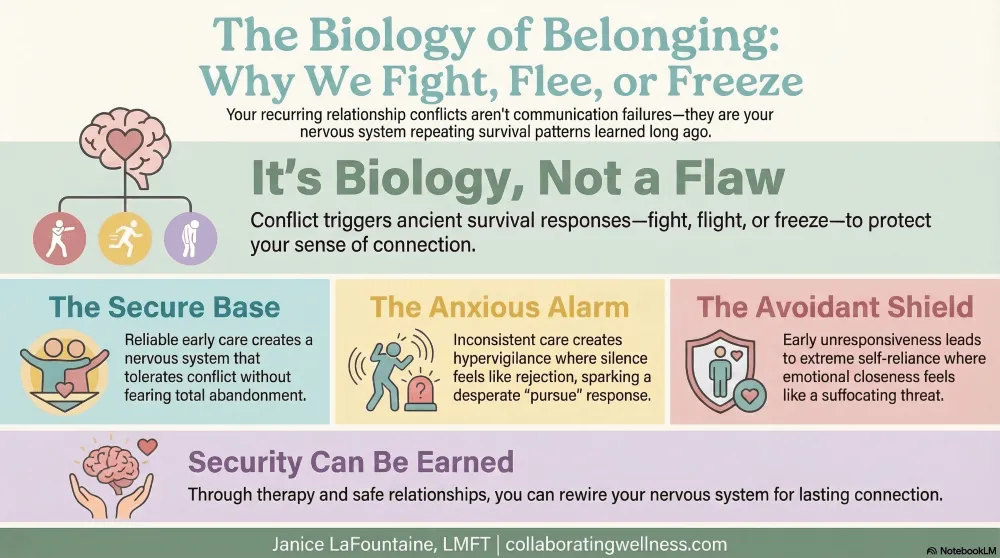
Here's something that might reframe everything: you aren't failing at communication. Your nervous system is doing exactly what it learned to do decades ago, long before this relationship existed. The way you fight, flee, or freeze when love feels threatened isn't a personality flaw — it's an attachment pattern. And attachment patterns are written into the body before we ever have words to describe them.
Understanding your attachment style — and the nervous system responses that drive it — is one of the most clarifying things you can do for your relationship. Not because it excuses harmful behavior, but because you cannot change a pattern you can't yet see. This article will help you see it.
Why Was Your Nervous System Built for Connection?
Attachment style is the characteristic pattern of emotional and behavioral responses you bring to close relationships, shaped by your earliest experiences with caregivers. Bowlby (1969) and Ainsworth (1978) identified these patterns as the nervous system's blueprint for connection—not a personality trait, but a learned survival strategy.
To understand attachment, you first have to understand what your nervous system is actually doing when conflict arises. Psychiatrist and researcher Stephen Porges developed what's known as Polyvagal Theory — a framework that explains how the human nervous system is wired, above all else, for social connection. Before it manages fight-or-flight, before it shuts down in freeze, the nervous system reaches first for another person.
When you feel safe and connected, your ventral vagal system runs the show. Your heart rate slows, your breathing deepens, your face is open and readable, and you can hear nuance in someone's voice. You're capable of empathy, negotiation, repair. This is the state we need to be in to actually talk — not just to make noise at each other.
But the moment your nervous system perceives a threat to that connection — a cold look, a raised voice, three days of distance — it doesn't wait for your prefrontal cortex to weigh in. It fires off an emergency response: fight (pursue, demand, escalate), flight (leave the room, stonewall, go numb), or freeze (collapse, dissociate, give up). These aren't conscious choices. They are body-level survival responses.
Here's where attachment enters the picture. Which emergency response your nervous system defaults to — and how quickly it fires — was largely determined in the first years of your life, based on whether the people closest to you were a source of safety or a source of threat.
"The way you fight, flee, or freeze in love isn't about your partner. It's about what your nervous system learned to do with fear before you were old enough to know you were learning anything at all."
What Attachment Style Actually Means
Attachment theory, developed by John Bowlby and expanded through decades of research, begins with a simple premise: human beings are wired to seek a secure base. As infants, we needed our caregivers not only for food and warmth but for nervous system regulation. A responsive caregiver didn't just feed us — they helped our overwhelmed little bodies calm down. They were the external regulation system we depended on before we could regulate ourselves.
Researcher Mary Ainsworth's landmark studies identified three primary patterns in how infants respond to caregiver availability: secure, anxious-ambivalent, and avoidant. A fourth pattern — disorganized — was later identified by Mary Main. These early patterns don't disappear when we grow up. They migrate. Research consistently finds a 70–80% correspondence between a parent's attachment style and their child's — these patterns transmit across generations, shaping how we seek (or avoid) closeness in every intimate relationship that follows.
Importantly, attachment styles aren't rigid categories you're locked inside forever. They're better understood as nervous system strategies — adaptive responses to the relational environment you grew up in. And strategies, unlike personality traits, can be updated.
Secure Attachment: When the Nervous System Feels Safe
People with secure attachment developed it because their early caregivers were consistently responsive — not perfect, but reliably present and able to repair ruptures. That consistency taught the nervous system a foundational truth: I can reach for connection, and connection will meet me.
In adult relationships, securely attached people can tolerate conflict without interpreting it as abandonment. They can ask for what they need without spiraling. When their partner is unavailable or distracted, they don't immediately catastrophize — they have an internalized sense of being loved that holds steady even in the absence of constant reassurance.
Crucially, secure attachment isn't about never getting activated. Securely attached people still feel hurt, afraid, and angry. The difference is in recovery — their nervous system returns to the window of calm connection more quickly, and they have the capacity to reach toward their partner rather than away.
If you didn't grow up with secure attachment, this isn't your destiny to miss. Research on earned security shows that what we call "secure" can be built through corrective relational experiences — including therapy, and including conscious, healing partnerships.
Anxious Attachment: The Nervous System on High Alert
Anxious attachment forms when early caregiving was inconsistent. Sometimes the caregiver was warm and responsive; sometimes they were unavailable, distracted, or emotionally volatile. The infant couldn't predict which version of the caregiver would show up. The nervous system's solution was to turn up the alarm system — stay hypervigilant for signals of disconnection and amplify attachment bids to ensure the caregiver would respond.
This hypervigilance follows anxiously attached people into adult relationships as a hair-trigger threat detection system. They read facial expressions and tone of voice for signs of impending abandonment. A partner's quietness feels like withdrawal. A slow text reply feels like rejection. The fear underneath all of this isn't irrational — it's the nervous system accurately reporting what used to be true, even when the current relationship is safer than the one it learned from.
When the anxiously attached nervous system is triggered, it tends toward fight and pursuit: escalating, demanding connection, interpreting silence as cruelty. What looks like anger from the outside is almost always panic on the inside. The underlying question — desperate and rarely spoken — is Do I matter to you? Am I going to lose you?
Signs of Anxious Attachment in Your Relationship
- You monitor your partner's moods closely for signs that something is wrong
- Conflict feels urgent and almost physically unbearable — you need resolution now
- When your partner withdraws, you pursue harder, even knowing it pushes them further away
- You interpret neutral behavior (tiredness, distraction) as evidence of emotional withdrawal
- Reassurance helps temporarily but never quite settles the underlying fear
- You often feel "too much" — too sensitive, too needy, too intense — in relationships
Avoidant Attachment: The Nervous System That Learned to Go It Alone
Avoidant attachment develops in response to caregivers who were consistently unresponsive — either emotionally unavailable, dismissive of distress, or uncomfortable with closeness. When every reach for comfort was met with coldness or rejection, the infant's nervous system learned to stop reaching. Emotional needs didn't disappear — they went underground.
Avoidant adults often describe themselves as independent, self-sufficient, and not particularly needing emotional intimacy. This self-perception is real and also, in part, a successful defensive strategy. The nervous system learned early that wanting connection was dangerous — that need would not be met, and reaching for it only brought pain. The solution was to deactivate the attachment system and become very good at self-reliance.
When avoidantly attached people feel emotionally crowded — when a partner pursues closeness, asks for more, or expresses strong emotion — the nervous system responds with flight: withdrawal, shutdown, emotional flatness, or a sudden and overwhelming need for space. What looks like indifference from the outside is often shame and overwhelm on the inside. The underlying question, rarely conscious, is: I can never get this right. There is no point in trying.
Signs of Avoidant Attachment in Your Relationship
- Emotional conversations feel physically suffocating — you need to exit or shut down
- Your partner's emotional needs feel like demands you can never adequately meet
- You feel most comfortable in relationships when there's plenty of space and independence
- During conflict, you go quiet, logical, or simply leave — and can't always explain why
- Closeness feels good in small doses but quickly tips into feeling trapped
- You've been told you're "emotionally unavailable" — and you're not entirely sure how to change that
Disorganized Attachment: When the Person You Need Is Also the Source of Fear? (When this pattern deepens, it can become trauma bonding.)
Disorganized attachment — sometimes called fearful-avoidant — is the most complex pattern, and the one most closely tied to early trauma. It develops when the primary caregiver was simultaneously the child's only source of comfort and a source of fear or threat. In that impossible bind, the child faces what researcher Mary Main called "fright without solution" — there is no safe direction to move. They cannot approach. They cannot flee. They cannot ignore the threat.
Adults with disorganized attachment often experience contradictory impulses in intimate relationships: they deeply want closeness and are simultaneously terrified of it. Love and danger have been neurologically linked. A partner moving toward them triggers both longing and alarm. This can look like pushing someone away immediately after moments of profound intimacy, cycles of idealization followed by sudden withdrawal, or relationships that feel perpetually destabilizing despite genuine love for the other person.
The nervous system in disorganized attachment doesn't have a consistent strategy — it learned that there was no strategy that worked. This is why disorganized patterns are so often misunderstood and why they respond so powerfully to trauma-focused therapy that works with the body rather than only with words.
What Happens When Two Attachment Styles Collide?
One of the most common — and most painful — relational dynamics emerges when an anxiously attached partner and an avoidantly attached partner find each other. And find each other they do, reliably, across cultures and continents. There's a reason for this: each triggers in the other the most familiar relational wound, and familiarity, even painful familiarity, can feel like coming home.
Gottman researchers call this the pursuer-distancer pattern. Emotionally Focused Therapy (EFT) therapist Sue Johnson calls it the "Protest Polka" — a dance both partners are trapped in together, neither of them fully choosing their steps. Here's how it runs:
The anxious partner experiences disconnection and their nervous system fires the alarm. They pursue: they escalate, criticize, demand. Beneath the pursuing behavior is panic and a desperate bid for reassurance — please, just let me know you're still here. The avoidant partner, flooded by the intensity of the pursuit, experiences this as an attack and their nervous system fires its own alarm. They withdraw: they go quiet, logical, or disappear. Beneath the withdrawal is overwhelm and shame — I cannot get this right. The safest thing is to disengage.
The pursuer's withdrawal confirmation triggers more pursuit. The distancer's sense of being attacked triggers more withdrawal. The cycle tightens. Both partners are now acting from their oldest, most survival-oriented nervous system states — and neither one is actually responding to the person in front of them. They are responding to everyone who came before.
"Beneath every pursuit is a longing for connection. Beneath every withdrawal is a fear of failing the person you love. These are not opposing needs — they are the same need wearing different clothes."
In my work with couples, the most diagnostic moment isn't usually a conflict — it's the moment one partner stops carrying the system. The reaching, the softening, the constant repair work that's been keeping the bond looking mutual. When that labor stops, what's actually there becomes visible. Not as a failure of the relationship, but as information. The pattern wasn't mutual; it was being held by one person. What both partners do with that information is where real attachment work begins.
Why Does Knowing Your Attachment Style Change Everything?
Understanding attachment styles shifts the frame of the conflict. Instead of you are too needy and you are emotionally unavailable, the question becomes: what is each of our nervous systems trying to protect us from, and what do we each most need to feel safe enough to stay open?
This reframe isn't about excusing harmful behavior. Patterns can be understood without being permitted to continue indefinitely. But the understanding itself creates a crack in the cycle — a moment of recognition that can change everything. When an anxious partner can name that they are in panic, not just angry, and when an avoidant partner can recognize that withdrawal is shame, not indifference, suddenly there is something to work with.
Gottman's research consistently finds that the content of a fight matters far less than whether both partners feel emotionally accessible, responsive, and engaged to each other. The dishes are never really about the dishes.
How Does Therapy Actually Rewire Attachment Patterns?
Because attachment patterns are stored in the body — in nervous system responses that operate faster than conscious thought — healing them requires more than insight alone. Understanding your pattern intellectually is a necessary first step. It is not the whole path.
EMDR therapy (Eye Movement Desensitization and Reprocessing) is particularly effective for attachment wounds because it targets the stored implicit memories that drive these patterns — the moments of abandonment, inconsistency, or terror that the nervous system is still, unconsciously, protecting against. EMDR allows those old experiences to be reprocessed so the body no longer has to brace against them in present-day relationships.
Emotionally Focused Therapy (EFT), developed by Sue Johnson, works directly with the attachment cycle in couples. Rather than focusing on communication techniques, EFT helps partners identify and soften the underlying attachment fears driving their conflict — and reach for each other from a place of vulnerability rather than defense. The goal is what Johnson calls an "A.R.E." bond: Accessible, Responsive, and Engaged.
Gottman Method couples therapy provides practical frameworks for recognizing and interrupting the pursuer-distancer cycle, building repair rituals, and creating the kind of day-to-day positive connection that makes both partners' nervous systems feel safe enough to stay in the room during conflict.
Attachment security can be earned at any point in life. The nervous system is not a fixed structure — it is a responsive, adaptable system that continues to learn from new relational experiences. This is one of the most hopeful findings in modern attachment research: safety, experienced repeatedly and consistently, rewrites the pattern.
Questions Worth Sitting With
- When conflict arises in your relationship, does your body want to move toward or away?
- What does emotional disconnection feel like in your body — where do you feel it?
- What early relationship taught you whether or not it was safe to ask for what you need?
- If your partner's withdrawal or pursuit triggers a strong reaction, what story does your nervous system tell about what it means?
- Is there a version of you — calmer, more open — that only shows up when you feel truly safe? What would it take to bring that person into your relationship more often?
You Are Not Your Pattern (Even After Betrayal)
Your attachment style is not your identity. It is a strategy your nervous system developed under specific circumstances, in response to specific people, at a time when you had no other options. It served a purpose. It kept you connected — or safe, or both — in the only way available to you then.
But you are not a child anymore. You have resources you didn't have then, and one of the most powerful of those resources is the capacity to understand what is happening inside you — and to choose, slowly and with support, to respond rather than react.
The fights you keep having are not proof that your relationship is broken or that you are beyond repair. They are your nervous systems, each doing what they learned to do, each hoping the other person will somehow make it safe enough to stop. That is a workable starting point. It is, in fact, exactly where healing begins.
Disclaimer: This content is for educational purposes only and does not constitute medical advice or establish a therapeutic relationship. If you're experiencing a mental health crisis, please contact 988 (Suicide & Crisis Lifeline) or your local emergency services.
Continue reading in the Couples and attachment series
- How Your Fight Cycle Is Really a Cry for Connection — the fight cycle that attachment panic drives.
- Broadcasting to the Void — when attachment bids go chronically unanswered.
- The Blueprint Burden — the invisible labor that emerges when one partner over-functions.
- Is It Really Trauma Bonding? — how attachment patterns shape vulnerability to trauma bonds.
- When Talk Therapy Hits a Wall — why attachment work requires body-based therapies.