Healing doesn't always look like a breakthrough. Sometimes it looks like noticing your cat is warm in your lap — and letting that matter.
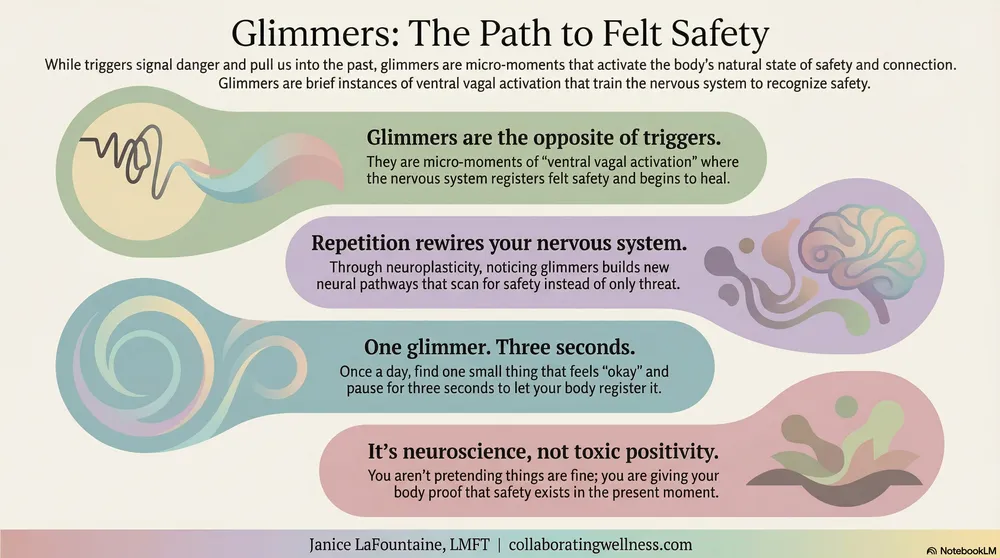
Glimmers are micro-moments of ventral vagal activation — brief instances when your nervous system registers safety without conscious effort. Identified by polyvagal theory researcher Deb Dana, glimmers are the neurological opposite of triggers: where triggers pull the nervous system into fight, flight, or freeze, glimmers activate the calm, connected state where healing actually occurs. For trauma survivors whose systems have been trained to scan for threat, learning to notice and register glimmers builds the neural pathway for safety recognition — a skill that supports and strengthens the deeper work of EMDR and trauma processing.
If you've been in trauma recovery for any length of time, you've learned to recognize triggers — the moments when your body floods with panic, your chest tightens, your mind goes blank, or you're suddenly back in that moment you've worked so hard to move past. You know what pulls you into hypervigilance, what sends you into shutdown, what makes safety feel unreachable.
But what about the opposite? What about the micro-moments when your nervous system whispers, this is safe? When sunlight through the kitchen window makes you pause? When a stranger smiles kindly and your shoulders drop half an inch? When your favorite song starts playing and something in your chest relaxes?
Those aren't just pleasant moments. They're called glimmers — and they're as neurologically significant as triggers. Maybe more so. Because while triggers pull you into the past, glimmers build the pathway to a regulated present. And for trauma survivors whose nervous systems have been trained to scan for threat, learning to notice glimmers is one of the most powerful rewiring tools available.
What Are Glimmers and Why Do They Matter?
The term "glimmers" comes from polyvagal theory researcher Deb Dana, who describes them as brief moments when your nervous system registers safety. Not cognitive safety — "I know I'm safe" — but felt safety. The kind your body recognizes before your thinking brain catches up.
Technically, glimmers are moments of ventral vagal activation — the state where your nervous system is calm, connected, and present. It's the opposite of fight, flight, freeze, or shutdown. It's the state where healing actually happens.
Glimmers aren't just nice moments. They're your nervous system practicing safety — and practice builds pathways.
Here's what makes glimmers so powerful for trauma recovery: your nervous system learns through repetition — a principle neuroscientists call experience-dependent neuroplasticity. If you've lived through prolonged stress, abuse, or coercive control, your system has had thousands — maybe tens of thousands — of repetitions scanning for threat. That's not paranoia; that's pattern recognition. Your nervous system got very, very good at a job it needed to be good at.
Glimmers give your nervous system a different job: noticing when things are okay. And every time you pause to register a glimmer — really register it, let it land in your body for even three seconds — you're building the neural pathway that scans for safety instead of threat.
Safety, it turns out, is a skill. And glimmers are how you practice it.
What Do Glimmers Look Like in Everyday Life?
Glimmers are quiet. They're easy to miss. For many trauma survivors, they've been filtered out for years because the hypervigilance system only cares about potential danger. But once you start looking for them, you'll realize they're everywhere.
Common Glimmers (You've Probably Felt These Without Naming Them)
- Physical comfort: A warm drink in your hands, soft fabric against your skin, cool water on your face, the weight of your pet in your lap
- Sensory moments: Morning light through the window, birdsong, the smell of rain, your favorite song starting
- Connection: A stranger's genuinely kind smile, eye contact that feels warm instead of intrusive, someone remembering a small thing about you
- Accomplishment: Finishing a task, crossing something off your list, your body doing what you asked it to do
- Beauty: A flower blooming, clouds moving, the way light hits the floor, something unexpectedly lovely
- Presence: Realizing you've been laughing, noticing you're not bracing, catching yourself feeling okay
What makes these glimmers rather than just "pleasant moments" is the body response. Glimmers don't require you to think your way into safety — they bypass cognition entirely. Your shoulders drop. Your breath deepens slightly. Something in your chest unclenches. Your jaw relaxes. You weren't trying to regulate; your nervous system just did it on its own because it registered something safe.
And here's the part trauma survivors often don't expect: you don't have to feel happy. You don't have to feel anything dramatic at all. A glimmer might be as subtle as three seconds where you're not actively bracing for impact. That's enough. That's the practice.
Why Do Trauma Survivors Miss Glimmers?
If you've lived in survival mode for months, years, or decades, your nervous system developed a very specific scanning pattern: threat detection. It's extraordinarily good at it. It will notice a microexpression, a shift in tone, a change in someone's posture — anything that could signal danger. That skill kept you alive.
But that same system filters out glimmers. Not because they're unimportant, but because they don't register as survival-relevant. Your hypervigilant nervous system doesn't care that the coffee smells good; it cares whether the person across from you is safe. It doesn't notice the sunlight; it's tracking exits.
This is why noticing glimmers is an active practice, not a passive one. You have to train your attention to catch them — and at first, it will feel unnatural. Your nervous system will want to dismiss them as irrelevant. "So what if the tea is warm? There's still danger out there." Yes. And the tea is still warm. Both are true. And one of them is happening right now, in your body, in a way that can build safety.
How Does the Glimmer Practice Work?
Once a day — just once — pause and ask yourself: "What's one small thing that feels okay right now?"
It might be your breath moving easily. The chair supporting you. A color you like. The fact that you're warm enough, or cool enough, or the light is just right. Something incredibly small.
When you find it, let yourself notice it for three full seconds. Not analyze it. Not dismiss it. Just let it exist in your awareness while your body registers it.
That's the whole practice. You're not trying to feel better. You're not trying to make the glimmer bigger than it is. You're just giving your nervous system three seconds to practice noticing when things are okay.
Over time — weeks, not days — this practice rewires the scanning pattern. Your nervous system starts catching glimmers on its own. You'll notice your shoulders dropping when you didn't consciously try to relax them. You'll catch yourself pausing at something beautiful. You'll register kindness before your hypervigilance interprets it as manipulation.
You're not abandoning your threat-detection system. You're giving it a partner.
How Do Glimmers Connect to EMDR and Trauma Therapy?
If you're working with a trauma therapist — especially if you're doing EMDR — you've probably heard about "resourcing." That's the part of therapy where we help your nervous system build anchors to safety: safe place imagery, container exercises, people or memories that feel stabilizing.
Glimmers are the real-world version of that. Resourcing happens in session; glimmers happen in your kitchen, on your walk, in the three seconds you pause to notice your dog is soft. EMDR installs the pathway; glimmers are the daily practice between sessions that keeps it active.
And here's why this matters for trauma processing: you cannot process trauma from a dysregulated state. Your nervous system needs enough ventral vagal capacity — enough access to that calm, present state — to metabolize what happened without retraumatizing yourself. Glimmers build that capacity.
Think of it this way: EMDR is the intensive work. Glimmers are the strength training that makes the intensive work possible. You're not choosing one or the other; you're building the foundation that lets the deeper work land.
What If Glimmers Feel Threatening?
For some trauma survivors — especially those who survived coercive control, prolonged abuse, or high-control environments — glimmers can feel dangerous.
If safety was weaponized against you — if calm moments preceded violence, if kindness was bait, if you learned to distrust ease because the next blow always came when you let your guard down — then your nervous system might panic when you notice a glimmer. It might feel like you're being lulled into complacency. Like you're about to get hurt.
If that's your experience, start smaller. You don't need to force yourself to "appreciate" glimmers or feel grateful for them. You can notice them neutrally, the way you'd notice the color of a wall. "The tea is warm. That's a fact. Moving on." No attachment, no meaning, no requirement that it change how you feel.
Over time, as your nervous system learns that noticing warmth doesn't precede harm, the resistance will soften. But you don't have to rush it. Glimmers aren't another thing you're failing at if they don't feel good yet. They're just data. And data is safe.
Is Noticing Glimmers Toxic Positivity?
Let's be clear: noticing glimmers is not about pretending everything is fine. It's not "good vibes only." It's not minimizing what you've survived or asking you to be grateful for suffering. It has nothing to do with positivity at all.
Glimmers are a nervous system intervention. They're about giving your body the repetitions it needs to rebuild the capacity for regulation. You can hold both truths at once: what happened to you was real and devastating, and your nervous system can learn to recognize safety again.
In fact, for many trauma survivors, the ability to notice glimmers is a sign that the hardest work is starting to integrate. Because when you're in acute survival mode, you can't notice glimmers. Your system won't let you. The fact that you're able to pause, even for three seconds, to register warmth or light or softness — that's not bypassing your trauma. That's your nervous system signaling it has enough bandwidth to begin rewiring.
You're not pretending the trauma didn't happen. You're teaching your body that the trauma isn't happening right now.
What If Noticing Glimmers Feels Indulgent?
Here's the part that stops many trauma survivors from even trying the glimmer practice: it feels indulgent. Frivolous. Like you're wasting time on something that doesn't matter when there's still so much work to do.
If that resonates, let me offer you this: you are allowed to notice when something is okay. Even if everything else is hard. Even if you're still healing. Even if you haven't "earned" it by fixing everything first. You're allowed to let your cat's warmth matter. You're allowed to pause at the light through the window. You're allowed to register kindness without immediately scanning for the trap.
This isn't self-care fluff. This is the unglamorous, repetitive, neurological work of rewiring a traumatized system. And it works not because it's pleasant — though sometimes it is — but because it gives your body proof that safety exists. Not as an idea. As a felt experience. Three seconds at a time.
Start there. One glimmer. Three seconds. Let your nervous system practice the skill it needs most: recognizing when things are okay.
If you're working through trauma recovery and finding that your nervous system is stuck in hypervigilance or shutdown, trauma-informed therapy can help you build the capacity for regulation that makes healing possible. Janice LaFountaine, LMFT, works with individuals and couples in Washington and Idaho using EMDR, attachment-focused therapy, and nervous-system-informed approaches that honor where you are while building the pathways to where you're going.
Disclaimer: This content is for educational purposes only and does not constitute medical advice or establish a therapeutic relationship. If you're experiencing a mental health crisis, please contact 988 (Suicide & Crisis Lifeline) or your local emergency services.
Continue reading in the Trauma recovery and healing series
- When Talk Therapy Hits a Wall — why insight-focused work sometimes can't reach the body's hold of trauma.
- When Healing Means Finding Who You Actually Are — identity restoration alongside nervous system regulation.
- The Invisible Prison: Understanding Coercive Control — the framework that names why safety can feel threatening at first.
- Understanding Your Attachment Style — why some nervous systems resist safety cues more than others.
- Is It Really Trauma Bonding? — the bond pattern that glimmers practice can help unwind.