The Missing Piece in Trauma Recovery: When Healing Means Finding Who You Actually Are
Identity restoration is the recovery work that begins after safety has been re-established — when survivors of coercive control, high-control groups, or manipulative family systems find themselves asking who am I now? even after the nervous system has settled. Coercive systems work by systematically dismantling a person's relationship with their own perceptions, feelings, and inner knowing — replacing internal authority with external dependence. What survives is often a pseudo-identity: a protective construction built to navigate an unsafe environment, which doesn't simply dissolve when the threat ends. This article is for survivors who've completed or are partway through trauma-informed therapy, regulated their nervous systems, and discovered that safety and self are not the same thing. It explains what coercive control takes at the level of identity, why grief arrives even when leaving was right, and what the work of finding yourself again actually looks like. Janice LaFountaine, LMFT, supports this stage of recovery with clients throughout Washington and Idaho via telehealth and in-person sessions.
You left. You're in therapy. You're not in immediate danger anymore. By every external measure, you're doing the work — and it's working. The hypervigilance has softened. You sleep better. You've learned to name what's happening in your body when old patterns surface. In a lot of ways, you're more regulated than you've ever been.
And yet. There's a question underneath all of it that keeps surfacing, quiet and persistent: Who am I now?
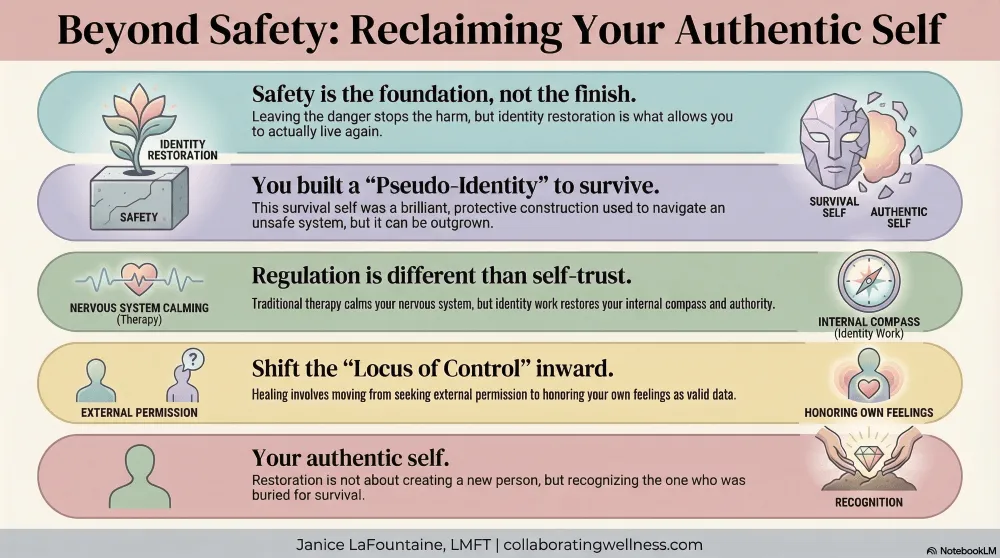
This question is not a sign that something has gone wrong in your recovery. It's a sign that you're ready for the next layer. Because here's what many trauma survivors discover partway through the healing process: getting safe and getting yourself back are not the same thing. Safety is the foundation. Identity restoration is what gets built on it. And coercive control — whether in an intimate relationship, a high-control group, or a manipulative family system — makes that second task extraordinarily complex.
What Does Coercive Control Actually Take from You?
Identity erosion is the gradual loss of authentic selfhood that occurs under sustained coercive control. Herman (1992) describes this as one of the most devastating consequences of prolonged trauma—not just what was done to you, but who you were forced to become in order to survive it.
Most people understand coercive control as a pattern of behavior — the isolation, the monitoring, the rules, the unpredictable consequences. All of that is real and clinically significant. But there's a dimension of coercive control that gets less attention, and it's the one that shapes recovery most profoundly: the systematic dismantling of your relationship with your own inner knowing.
Coercive control works, at its deepest level, by convincing you that your perceptions are unreliable, your feelings are excessive, your judgment cannot be trusted, and your sense of yourself is fundamentally flawed. This isn't accidental. It's the mechanism. When you can no longer trust your own reading of a situation — when the internal compass that every person depends on to navigate their life has been consistently overridden, mocked, or punished — you become dependent on an external source of reality. That dependency is what coercive systems require to function.
Researchers and clinicians who specialize in coercive control have described this as a form of identity erosion — not a sudden breaking, but a slow, systematic replacement. The person you were before the relationship or group had instincts, preferences, a particular way of reading a room, things that felt true and things that felt wrong. Coercive control doesn't just suppress those things. It teaches you they were never reliable to begin with.
"Coercive control doesn't just take your freedom. It takes your access to yourself — to the inner voice that knows what you feel, what you need, and what is true."
What Did You Build to Survive?
In response to a coercive environment, something very intelligent happens. You build a version of yourself that can survive there. Clinicians sometimes call this a pseudo-identity — not a fake self in any shameful sense, but a protective construction: a way of being that minimizes threat, meets external demands, and keeps you as safe as possible inside an unsafe system.
This pseudo-identity can be remarkably elaborate. It knows exactly what the controlling person or group needs to see. It has learned which emotions are permitted and which are dangerous. It has internalized the rules so thoroughly that it no longer has to consciously consult them. It is, in every measurable way, a survival achievement — evidence of your adaptability and intelligence under conditions that most people cannot fully imagine.
The problem is not that you built it. The problem is what happens when the threat is removed and the pseudo-identity is no longer needed — because it doesn't simply dissolve. It has been, in many cases, the only functional self you've had access to for months or years. The authentic self underneath it — the one with the instincts and preferences and inner knowing — has been so thoroughly suppressed that finding it again can feel like searching for someone you're not entirely sure still exists.
What the pseudo-identity sounds like from the inside
- "I don't know what I actually like anymore — my preferences always felt like a liability"
- "I can read other people's emotions instantly, but I have no idea what I'm feeling"
- "Even with people who are safe, I'm always performing — I don't know how to just be"
- "I left months ago and I still feel like I'm waiting for permission to make my own decisions"
- "The therapy is helping but I still feel like a stranger to myself"
In my work with survivors of coercive systems, the single most consistent wound I see is the loss of trust in one's own inner compass. It shows up quietly in session: a client says something true, then pauses and waits for my reaction before letting themselves believe it. The work of identity restoration is almost never dramatic. It is noticing that pause. It is the small, repeated practice of letting a preference, a feeling, a knowing stand on its own — without needing anyone else to ratify it first.
Why Leaving Feels Like Grief — Even When You Wanted to Leave
One of the most disorienting experiences in coercive control recovery is the grief that arrives after leaving — sometimes immediately, sometimes months later. Survivors often feel ashamed of this grief. They left because the situation was harmful. They made the right choice. So why does it feel like loss?
Part of what is being grieved is the pseudo-identity itself. When the coercive environment ends, the identity that was built to survive it loses its entire organizing structure. The role that gave you definition — even a painful, constrained definition — is gone. And the authentic self that might fill the space hasn't been accessed, in some cases, for a very long time. That gap, between who you had to be and who you actually are, is real. The disorientation it produces is not weakness. It is the predictable experience of a self in the process of reconstruction.
Clinicians who specialize in this area note that survivors sometimes describe the period after leaving as feeling emptier than the relationship itself — not because the relationship was good, but because the pseudo-identity at least had a shape. Freedom, without a self to inhabit it, can feel terrifying rather than liberating. This is normal. It is not permanent. And it is not a reason to return.
What Gap Does Traditional Therapy Often Miss?
Trauma-informed therapy does essential work: it helps regulate the nervous system, processes traumatic memories, reduces hypervigilance, and rebuilds a basic sense of safety in the world. For many people, this is transformative, and it is genuinely necessary. It is not, however, always sufficient — particularly for survivors of coercive control.
Here is why: nervous system regulation restores the capacity for safety. It does not, by itself, restore the capacity for self-trust. And self-trust — the ability to access your own perceptions, honor your own feelings, and treat your inner knowing as a legitimate source of guidance — is precisely what coercive control targeted most systematically.
A survivor can complete a full course of somatic trauma therapy, regulate beautifully, and still find themselves asking their therapist, their partner, their friend — what do you think I should do? — in situations where they fundamentally know the answer and are simply unable to trust that they know it. That inability is not a symptom of incomplete trauma processing. It is a specific injury to the self — to the internal authority that coercive environments deliberately and systematically undermined.
Addressing it requires more than symptom reduction. It requires working at the level of identity — which means asking not only what happened to you but who you are underneath what happened, and building a therapeutic process that helps you find your way back to that person.
What Does Identity Restoration Actually Look Like?
Identity restoration isn't a single technique or a discrete phase of treatment. It's a reorientation of the entire therapeutic project — from managing symptoms to reclaiming the self that survived them. In practice, this work tends to move through several recognizable territories.
Rebuilding access to your own experience. Coercive control teaches you that your feelings are unreliable — too much, wrong, dangerous. Early identity work involves simply learning to notice what you feel without immediately questioning whether you should feel it. This is slower than it sounds for survivors whose internal experience has been systematically overridden. The goal is not emotional fluency right away — it's the beginning of a relationship with your own felt sense as a valid source of information.
Distinguishing conditioned responses from authentic preferences. The pseudo-identity has preferences too — but they were shaped by what was safe or required, not by who you actually are. Part of identity restoration involves learning to tell the difference: Do I actually not like this, or was I taught that people like me don't like this? Am I genuinely uncertain, or am I waiting for permission to be certain? These distinctions are subtle and often require patient, nonjudgmental exploration.
Restoring the inner compass. Every person has an internal orienting system — a capacity to sense what is aligned with who they are and what isn't, what feels right and what feels off, what moves them toward their actual life and what pulls them away from it. Coercive control doesn't destroy this system. It buries it under layers of doubt, overrides, and installed fear. Recovery includes excavating it — learning to recognize it again, and then slowly, with accumulating evidence, learning to trust it.
Shifting the locus of control inward. Coercive systems require external locus of control — the belief that truth, safety, and reality are determined by someone outside yourself. Healing requires systematically reversing this. Not through self-help affirmations, but through the gradual, corrective experience of making decisions from the inside out, observing that your inner knowing was trustworthy, and building an internalized authority that belongs to you.
Signs that identity restoration work is underway
- You notice a preference or opinion arise — and you let it stand, rather than immediately editing it
- You feel discomfort in a situation and trust that discomfort as data, rather than a symptom to manage
- You make a small decision from the inside out and discover, afterward, that you knew the right answer all along
- Something that once felt essential to your identity now feels like a costume you wore — and you can tell the difference
- You disagree with someone — a friend, a therapist, anyone — and the disagreement doesn't feel like a crisis
- You begin to know, in small and then larger ways, what your actual life looks like
The Person Who Was Always There (See also: The Invisible Prison and When Talk Therapy Hits a Wall)
One of the most important things to understand about identity restoration is that it is not the creation of a new self. You are not building someone from scratch. You are returning to someone who has been there all along — quieted, suppressed, waiting — underneath everything that was layered over them in the service of survival.
This is why survivors so often describe moments of identity restoration not as discovery but as recognition — as meeting again someone they once knew. A feeling of this is me, actually. A preference that surprises them with how clear it is. A boundary that arises not from a rule but from a genuine inner sense of what belongs in their life and what doesn't.
The work of recovery from coercive control is, at its deepest level, the work of clearing enough space for that person to reemerge. It is slow, sometimes disorienting, and genuinely one of the more profound processes a human being can move through. It is also possible. The self that was buried under years of override and erasure is not gone. It simply needs the conditions — safety, patience, and a therapeutic approach that takes the question of who you are as seriously as it takes the question of what happened to you — to find its way back to the surface.
If you are in recovery from coercive control and find yourself asking who am I now? — that question is not a sign that healing has failed. It is the beginning of the most important part.
Disclaimer: This content is for educational purposes only and does not constitute medical advice or establish a therapeutic relationship. If you're experiencing a mental health crisis, please contact 988 (Suicide & Crisis Lifeline) or your local emergency services.
Continue reading in the Trauma recovery and healing series
- The Invisible Prison: Understanding Coercive Control — the framework that names what was taken — and what can be rebuilt.
- When Talk Therapy Hits a Wall — why insight alone doesn't reach the identity erosion coercive control causes.
- Is It Really Trauma Bonding? — the bond that had to be understood before identity work could begin.
- Understanding Your Attachment Style — the attachment patterns that shaped who you became in order to survive.
- Glimmers — the small moments that teach the nervous system safety exists.