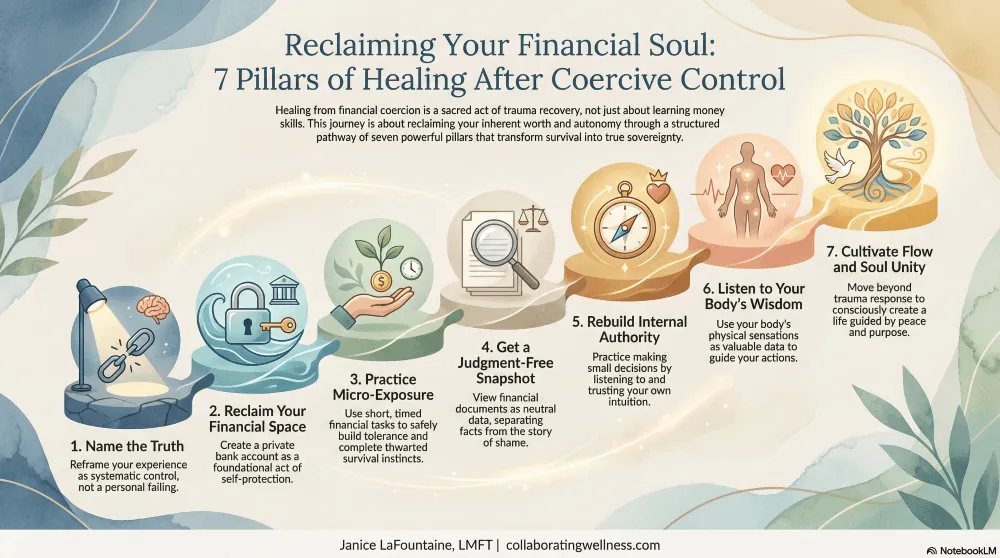
Reclaiming Your Financial Soul: Rebuilding Autonomy After Coercive Control
Financial abuse is a pattern of coercive behavior in which one person uses money, credit, or economic resources to control, exploit, or trap another person in a relationship. According to the National Network to End Domestic Violence (NNEDV), financial abuse occurs in approximately 99% of domestic violence cases. Judith Herman, in her foundational work Trauma and Recovery, identifies the restoration of autonomy—including financial autonomy—as a core task of the second stage of trauma recovery.
You did not break. You adapted.
Every symptom you carry—the hesitation before opening a bank statement, the panic when a bill arrives, the deep wells of shame about money—is evidence of a nervous system that learned to survive systematic control. But surviving is not the same as living. And your journey toward financial sovereignty is not about becoming "smarter with money." It is a sacred act of trauma recovery.
This is the core of Soul Unity Therapy: we approach healing not as fixing a flaw but as integrating the fractured parts of yourself—the capable mind, the adaptive nervous system, and the worthy soul. Your return to financial health is a return to you.
If you haven't read it yet, The Financial Coercion Blueprint details exactly how money becomes a weapon of control. What follows here is the healing pathway forward—structured by five powerful pillars that transform survival into true sovereignty.
What Does It Mean to Name the Financial Abuse You Survived?
The control began with a lie: the lie that you were incompetent and the lie that your fear was unwarranted. The first pillar of reclaiming your financial soul is to break the spell of that lie through the power of truthful language.
Lundy Bancroft, whose book Why Does He Do That? remains one of the most clinically useful guides to understanding the mindset of controlling partners, is direct about this: the abuser's goal is not merely to manage money but to manage you. Financial control is never about finances. It is about engineering your dependency so thoroughly that leaving feels impossible. Naming this system for what it is—financial coercion—is the first act of resistance.
In The Body Keeps the Score, Dr. Bessel van der Kolk explains that trauma often silences the brain's speech center—what he calls "speechless terror." When you have language for what happened, the raw experience begins to shift from the emotional right hemisphere to the rational left hemisphere where it can be processed. Stop saying "I'm bad with money." Start saying: "I survived a systematic pattern of financial coercion designed to make me believe I was incompetent."
Soul Unity Step: This is an act of Active Consciousness—shifting from diagnosing your perceived flaws to recognizing the brilliant adaptation of your survival. The confusion you feel around money is not evidence that they were right about you. It is evidence of what they did to you.
How Do You Create Safe Financial Space After Control?
Coercive control demolishes boundaries—physical, emotional, and financial. Reclaiming your space is the foundational step in training your nervous system that you are safe to move and act autonomously.
The external boundary is concrete: opening a bank account the abuser does not know about. Having a credit card in your own name. Directing a portion of income into a space that belongs only to you. If you are still in the relationship, this step requires safety planning—financial separation can escalate a controlling partner's behavior, and understanding the dynamics of coercive control can help you assess that risk.
The internal boundary matters just as much. Every time you make a financial decision—no matter how small—without asking permission, you send a signal to your nervous system: I am capable. I am safe. I am separate. Herman calls this the restoration of "ordinary social life"—the slow, unglamorous work of reclaiming the daily activities that coercive control stole from you.
Soul Unity Step: This pillar embodies the essential maternal element of Protection. You are actively choosing to become your own protector—creating a safe, stable, and nurturing relationship with yourself and with money.
Why Does Opening a Bank Statement Make Your Body Panic?
The compulsion to freeze, panic, or dissociate when facing financial tasks is not laziness or avoidance. It is a trauma response. Your body learned that financial activity was dangerous—because in the context of your abuse, it was. Opening a statement might have led to interrogation. Spending money might have triggered rage. Your nervous system is doing exactly what it was trained to do: protecting you from threat.
Healing requires completing the action your body couldn't safely complete before—but in small, survivable increments. Van der Kolk's research shows that the body stores traumatic memory in sensory and motor pathways, not just in narrative memory. This means your recovery has to include the body, not just the mind.
Practice: The Five-Minute Financial Task
Choose a financial action that causes a physiological shift—a tightening in your chest, a clench in your jaw, a desire to flee. Set a timer for five minutes. Do a tiny piece of the task. When the timer goes off, stop. Stand up. Shake it out. Notice that you survived.
Pay attention to what your body does during those five minutes. The stomach clench when you see a number. The held breath while you type a password. These are not signs of failure—they are data. Your body is telling you a story about fear you survived, and every time you complete the five minutes safely, you are rewriting the ending of that story.
Soul Unity Step: This is the practical implementation of Emotion Integration combined with Brain-Body Integration. You are intentionally creating micro-corrective emotional experiences where the outcome is safety rather than chaos—and using your body's wisdom as a guide, not an obstacle.
How Do You Look at the Numbers Without Drowning in Shame?
The most damaging legacy of financial abuse is the shame that convinced you of your own incompetence. Your credit score, your debt, the gaps in your employment history—these are not measures of your character. They are the wreckage left behind by someone else's control.
Marsha Linehan, the creator of Dialectical Behavior Therapy, teaches that suffering amplifies when we fight reality rather than facing it. Her "Check the Facts" skill applies powerfully here: gather your financial documents and write down every number as a neutral fact. Separate the data from the story your abuser wrote about what the data means.
A credit score of 520 is not proof that you are a failure. It is a record of what was done to you. A savings account with $47 in it is not evidence of incompetence. It is evidence of survival on resources someone else controlled. These are facts. The story of shame around those facts was written by the person who needed you to believe you couldn't manage without them.
"Your financial situation is not a reflection of your worth. It is a record of what you survived. Read it like evidence of your endurance—not your failure."
Soul Unity Step: You are shifting from the frightened child collapsing into shame to the observing Wise Adult capable of making a decision. This foundational step moves you toward an Internal Locus of Control—reclaiming the narrator of your own story.
What Does It Take to Trust Your Own Judgment Again?
The abuser systematically taught you to look outside yourself for every decision. That training doesn't vanish the day you leave. Months or years later, you may still freeze in the grocery store, unable to decide whether you're "allowed" to buy the more expensive shampoo. That freeze is not about shampoo. It is about a nervous system that learned that independent decisions are dangerous.
Rebuilding internal authority means actively retraining your brain to prioritize your own signals. Herman calls this the hallmark of the final stage of trauma recovery: the capacity to "take concrete steps to increase [one's] sense of power and control." Start with micro-decisions. Practice making small, daily financial choices—and then notice that nothing terrible happens.
Before acting, pause and ask: "What does my intuition tell me is the safest, most aligned choice right now?" Then act on that inner voice. The goal isn't perfection. It's building tolerance for making decisions without shame. Every choice is data, not an indictment of your character. Over time, those micro-decisions accumulate into something extraordinary: the lived experience of being a person who trusts herself.
If you recognize yourself in these patterns, you may also find resonance in the broader recovery process described in living with and leaving a narcissistic partner—where financial control is often one thread in a much larger web of coercive dynamics.
Soul Unity Step: This is Resonance and Alignment—the practice of trusting your own judgment as the most powerful act of self-reclamation after coercive control. When you surrender into that trust, decisions arise from inner knowing rather than mental struggle. This is Flow and Soul Unity: the conscious creation of your life from a place of intact worth.
How Do You Know You're Healing?
Healing from financial abuse doesn't look like a perfect credit score or a fully funded savings account. It looks like ordinary moments that used to be impossible:
Opening an envelope from your bank without your hands shaking. Buying something you want without an internal argument about whether you deserve it. Looking at your financial reality with clarity instead of shame. Making a decision about money and feeling—for the first time in a long time—that you trust yourself to make it.
The ultimate goal of financial autonomy is not a perfect budget. It is peace. Purpose. Flow. You reclaim your financial soul when you move beyond the trauma response into the conscious creation of your life—when your worth is no longer contingent on anyone else's permission.
"You did not break. You adapted. And now you are doing something even harder than surviving—you are choosing to live."
If you're in Washington or Idaho and these patterns feel familiar, I'd be honored to walk this path with you. I work with survivors of coercive control, financial abuse, and complex trauma through EMDR and trauma-informed therapy. This work is possible. And you've already proven you have the strength for it—you survived.
Janice LaFountaine, LMFT, works with individuals navigating coercive control recovery, complex trauma, and the specific wounds of financial abuse. She offers EMDR and trauma-informed therapy via HIPAA-compliant telehealth throughout Washington and Idaho.
Disclaimer: This content is for educational purposes only and does not constitute medical advice or establish a therapeutic relationship. If you're experiencing a mental health crisis, please contact 988 (Suicide & Crisis Lifeline) or your local emergency services. If you are in immediate danger, please call 911 or contact the National Domestic Violence Hotline at 1-800-799-7233.
Continue reading in the Coercive Control recovery series
- The Financial Coercion Blueprint — how financial control is engineered, naming what you survived.
- The Invisible Prison: Understanding Coercive Control — the parent framework: isolation, control, regulation of daily life.
- Is It Really Trauma Bonding? — the bond neurobiology that keeps survivors tethered after leaving.
- When Healing Means Finding Who You Actually Are — identity restoration as the next layer after nervous system safety.
- Understanding Your Attachment Style — why leaving can feel unsafe even when staying costs more.