When 'Narcissist' Isn't the Whole Story: Recognizing the Coercive Control Pattern:
Most people arrive at the word narcissist the same way: slowly, and then all at once. They’ve been explaining a pattern to a friend, or lying awake trying to name what is happening, and the word surfaces because it fits something real. The contempt. The way a minor disagreement becomes a referendum on their worth. The fog that settles after a conversation that somehow ended with them apologizing. Reaching for that word isn’t a mistake—it’s the first act of recognizing a pattern that has no name yet. This article is for people who are in that moment, and who are ready to see whether another frame—coercive control—might open something the narcissism frame doesn’t.
Understanding Narcissistic Abuse and Coercive Control
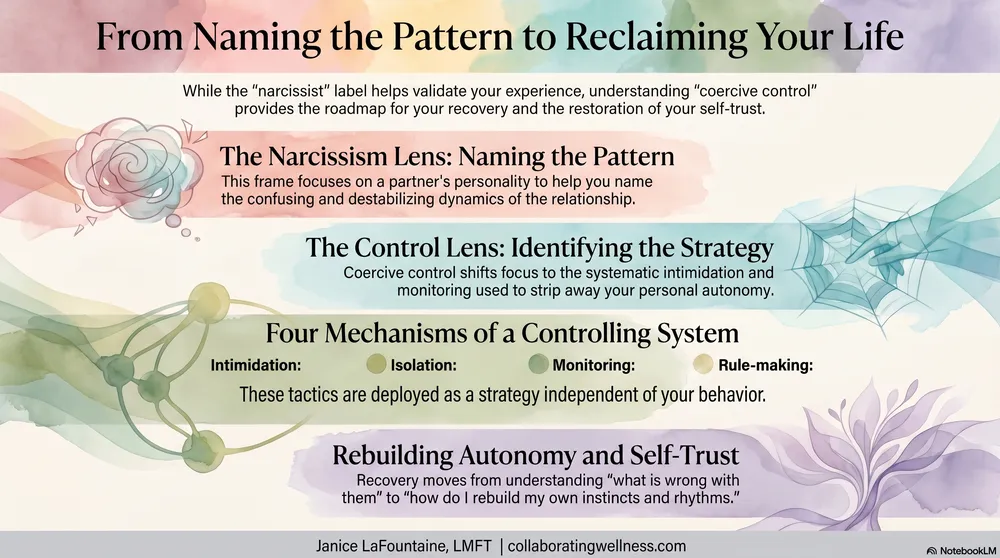
Narcissistic abuse and coercive control describe overlapping but distinct experiences. “Narcissistic abuse” is the term most survivors reach for first—it captures relationships marked by manipulation, contempt, and emotional erosion, and it focuses on a partner’s personality. “Coercive control,” a clinical and legal framework developed by Evan Stark, focuses on the pattern itself: a sustained system of intimidation, isolation, monitoring, and rule-making that strips autonomy over time. The same relationship can be described by both. The difference matters because each frame opens different paths—narcissism centers identifying a personality type, coercive control centers identifying a strategy. For survivors, that shift can change how recovery, safety planning, and self-trust are approached. Janice LaFountaine, LMFT, works with survivors of narcissistic relationships and coercive control throughout Washington and Idaho via telehealth and in person.
Both frames are useful. Neither is complete on its own. What this article explores is what each one illuminates—and what becomes visible when you hold them together. If you’ve been using the word narcissist and something still feels unnamed, what follows might help.
This isn’t a diagnostic framework. It’s a way of thinking with two lenses instead of one.
Why “Narcissist” Became the Word We Reach For
The word spread because it does real work. It gives people a name for a pattern that had previously felt unspeakable or unverifiable—relationships that left them confused, ashamed, and doubting their own perception. When someone first says “I think he might be a narcissist,” they are often not reaching for a clinical diagnosis. They are saying: something happened here, and I need language for it.
That is a legitimate and important thing. Naming the pattern is frequently the first repair. It lifts a weight of self-doubt that the relationship may have carefully constructed over months or years. Research on narcissistic personality patterns has helped explain why certain relationships feel destabilizing in ways that are hard to articulate: the grandiosity, the lack of empathy, the oscillation between idealization and contempt. These are real dynamics, and the framework that named them has genuinely helped survivors make sense of experiences that were previously unspeakable.
The word also spread through community—forums, social media, support groups where people who had lived through similar experiences found each other and named what had happened collectively. That community-building function is valuable in itself, separate from clinical precision. For more on why this particular language took hold the way it did, Why ‘Narcissist’ Became the Label We Can’t Stop Using explores the cultural moment in more depth.
What Coercive Control Names That Narcissism Doesn’t
Coercive control, as developed by researcher and forensic social worker Evan Stark, shifts the focus from who someone is to what is being systematically done. It describes a pattern—not a personality. Where the narcissism frame asks, “What does this person’s psychology look like?”, the coercive control frame asks, “What system has been built around this person, and what does it do to their autonomy?”
Stark’s framework identifies four core mechanisms:
- Intimidation — creating fear through threats, gestures, looks, damage to property, or unpredictability. Often no physical violence is necessary; the threat itself does the work.
- Isolation — cutting off access to friends, family, support systems, or information. This can be overt (forbidding contact) or subtle (manufacturing conflict with others).
- Monitoring — surveillance of movement, communications, finances, and relationships. The goal is to ensure that no action, thought, or decision happens outside the partner’s awareness.
- Rule-making — establishing a set of expectations about behavior, appearance, speech, and space that shift unpredictably, ensuring the partner is always slightly out of compliance.
The shift from personality to strategy is significant for survivors. When the frame moves to “a strategy was used against me,” the self-blame that so often follows these relationships starts to find somewhere else to go. Strategies are not responses to who you are—they are deployed independent of your behavior. Understanding that distinction is often where recovery begins to gain traction.
For a fuller exploration of how these tactics compound over time, What Is Coercive Control? Tactics That Build Over Time walks through each mechanism in detail.
What I listen for when a client says “I think he’s a narcissist” isn’t the label — it’s what they can’t put into words yet. They see the controlling behavior, the selfishness, patterns their partner learned from his own family of origin. But they’re reaching for a personality explanation when what’s in the room is a behavioral system. So we shift — from who he is to what he did. That’s when the lightbulb goes off, and we can look back through all the ways they were systematically manipulated.
What Narcissism Names That Coercive Control Doesn’t
Giving equal weight to both frames means being honest about what the narcissism frame does well that the coercive control frame doesn’t fully address.
Personality patterns matter clinically. Understanding that a partner has a deep-seated difficulty with empathy, a fragile self-concept organized around superiority, and a characterological tendency toward exploitation is useful information—not just for naming what happened, but for realistic recovery planning. If someone is working through grief at the loss of a relationship with a person who could not actually see them, that grief is different from the grief of losing someone who was simply overwhelmed or unaware. The narcissism frame can hold that particular kind of loss with more precision.
It is also worth noting that not every controlling partner has narcissistic personality organization, and not every person with narcissistic traits escalates to coercive control. The overlap is real, but the frames are not identical. Some individuals use control tactics learned from family systems, cultural conditioning, or past relationships—without the personality structure the narcissism frame describes. Treating the two as synonymous can make the coercive control frame seem redundant when it isn’t, and can leave some survivors without language for what they actually experienced.
For those navigating the lived texture of a narcissistic relationship—what it looks like day to day, how leaving unfolds, what remains afterward— Living With—and Leaving—a Narcissistic Partner addresses that more directly.
The Practical Difference for Healing
The two frames don’t just describe different things—they open different doors in recovery.
Treatment focus: Working from a narcissism frame tends to emphasize understanding the personality pattern, establishing and maintaining limits around contact, and processing the particular grief of having loved someone who could not reciprocate in kind. Working from a coercive control frame tends to foreground autonomy rebuilding—helping a person relearn what their own preferences, rhythms, and instincts actually are after years of having them overridden. These are not mutually exclusive, but knowing which is in the foreground shapes what work gets prioritized.
Safety planning: The coercive control frame surfaces ongoing-risk patterns that a personality focus can miss. Research consistently finds that separation in coercive control relationships—particularly those involving monitoring and isolation tactics—can represent a period of heightened danger. Understanding the system that was in place, not just the personality that drove it, changes how safety planning is approached before, during, and after leaving.
Recovery work: For many survivors, the deepest repair is about self-trust—learning again that their own perception is reliable, that their needs are real, and that their instincts about danger are worth listening to. This is the territory that trauma bonding work addresses, and it often runs alongside the autonomy work the coercive control frame makes visible. Financial autonomy, specifically, is its own dimension of recovery—one that the coercive control frame specifically names as part of the control architecture. The Financial Coercion Blueprint and Rebuilding Autonomy After Coercive Control go deeper on both.
Legal context: Coercive control is increasingly recognized in domestic violence proceedings in Washington state and beyond. Survivors who have lived primarily with non-physical control tactics often find that the coercive control frame gives their experience legal legibility that a physical-violence-only standard does not. Documenting patterns of intimidation, isolation, monitoring, and financial control can matter in custody proceedings and protective order applications in ways the narcissism frame does not directly support.
How to Hold Both Frames at Once
You do not have to choose.
Survivors often find that different frames become useful at different points in recovery. The narcissism frame tends to be most helpful early—when the first work is simply naming that something happened, that it was not imagined, and that the pattern has a recognizable shape. The coercive control frame often becomes more useful as recovery deepens, when the question shifts from what is wrong with him to what did this do to me, and how do I rebuild from here.
The frame is a tool, not a verdict. It does not define what happened—your lived experience does. A frame is useful when it helps you think more clearly, take better care of yourself, or plan more safely. When it stops doing that, you can set it down.
Trust what your felt sense already knows. It has likely been working on this longer than any framework has.
When to Reach Out
If you are in the middle of trying to name what happened—or what is still happening—working with a therapist who understands both the clinical reality of coercive control and the neuroscience of attachment disruption can change the pace and direction of recovery.
The disorientation that follows these relationships is not a character flaw. It is a nervous-system response to a system that was specifically designed to make self-trust difficult. That is workable. It takes time, and it takes the right support—and it is workable.
When you’re ready, you can book your initial appointment.
If you are experiencing a mental health crisis, please call 988 (Suicide & Crisis Lifeline) or go to your nearest emergency room.
Keep Exploring
Janice LaFountaine, LMFT, works with survivors of coercive control, narcissistic relationships, and complex trauma throughout Washington state and Idaho via HIPAA-compliant telehealth. She specializes in EMDR therapy, attachment-focused treatment, and the particular work of rebuilding self-trust after relationships designed to erode it.
This article is for educational purposes only and does not constitute therapy, a clinical assessment, or a substitute for professional mental health care. If you are in an unsafe situation, please contact the National Domestic Violence Hotline at 1-800-799-7233 or text START to 88788.